
Better Understanding Weaponry: Rifle Addendum 1 - Rifle Configurations
Added 2017-08-12 17:09:09 +0000 UTC
Because Life is Complicated in Every Conceivable Way, Why Wouldn’t Rifles Be Too?
Last week, I laid out the groundwork for better understanding the human race’s main infantry weapon, the rifle. Now, I’m going to outline all the way that groundwork “isn’t always,” because even without actually building and designing them, guns themselves are sort of a trade. And if you work in a trade, you know nothing is ever as simple as it’s laid out at the 100 level, even if it didn’t seem that simple to begin with.

WHERE IS YOUR GOD NOW, SMALL ONE?
So it’s time to bring out the weed-whacker early, and start knocking down preconceptions about long guns before their roots sink in. Remember what I said about memetic design and the M1 Garand, how the entire videogame industry thought you unload the thing like a musket by firing it until empty? Yeah, preconceptions made that happen. So prime it, and let’s pull the cord on this thing.
If there is something that boils down to a “standard” configuration of a rifle- and there largely isn’t, they all have their own individual features and quibbles -it could be thought of a ranged weapon very similar to what I showed you in the SCAR-17, the rifle I used in the my parts breakdown image last time. Which is to say, a self loading, high capacity (20 rounds) weapon that fires a rifle cartridge from a chamber situated ahead of the trigger mechanism, pushing its projectile down a barrel that’s about 18 to 20 inches (about 45 to 50cm) long.
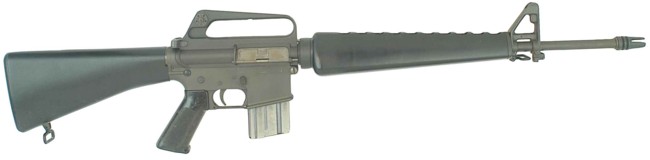
Hey look, an early M16. Speak of the devil!
You can probably figure that rifles deviate from this design a lot, and you’re probably already starting to pick up on some features you’re not seeing up above that you saw with a more modern and advanced weapon system. But those are individual features, that may be shared between weapons or straight up one off oddities. That said, some features are significant, and spread across different designs, and have even created their own forks of established weapon designs.
The Carbine

On the top, the M4A1 Carbine. On the bottom, the M16A4 Rifle. Differences abound. But mostly the shortness.
Packing similar firepower in a similar package, carbines are shortened and lightened rifles, designed to fit into smaller spaces. You’ll also note the collapsing stock on the M4A1, which allows it to telescope down and pack in a smaller space, or just stay out of your way more when you have it slung. They also have shorter barrels to decrease overall weight. While some believe this reduces their effective range do to assorted Ballistic Science Stuff, what we’re starting to see is the use of thicker, heavier barrels to compensate. Because apparently, that works, and I need to look into the research more to see why. We’re all learning, here.
All of these things are desirable, especially in the case of the above pictured weapons, or more specifically, the nation that employs the most of them, the US. See, the US Army has actually replaced rifles with carbines as their actual combat standard issue for infantry, leaving the rifles for rear echelon personnel and reservists. The reason for this is myriad, but mainly because of that thing I said about the use of main infantry weapons in modern warfare, how they’re used to pin down targets so bigger guns and aerial ordnance can get in the mix and start doing major damage. Turns out, carbines are just as able to do that just as well, with the plus side of being smaller, lighter and more maneuverable in tight spaces. In fact, carbines are just in general really good at doing things other weapons classes do- we’re starting to see the gradual phasing out of the submachine gun, because carbines do what they do exactly how they do it, but instead of doing it with a less powerful pistol cartridge like an SMG does, carbines do it with a powerful and higher velocity rifle round. Hell, you may even see them start to take the place of shotguns in close quarters combat, but shotguns will always have their place, because without going into detail, there’s a lot of things you can shoot out of a shotgun that isn’t a pellet or slug, and also, no door hinge will fear a rifle like it will a shotgun.
The Bullpup
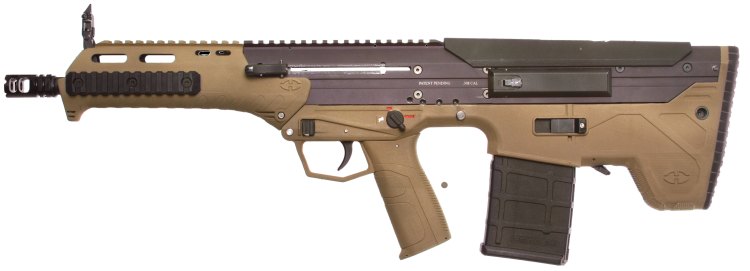
The Desert Tech MDR in .308: I’ll Take 10, Please.
So get rid of that conception that the chamber and magazine of a rifle has to go ahead of the trigger mechanism. That isn’t always the case. Behold, the bullpup, where it is in fact never the case! A more roundabout and wizard-like way of solving the carbine riddle. See, bullpups always have fixed stocks, and the reason for this is because unlike other rifles, the part of bullpup rifles that is the actual gun lives back there, rather than it just being maybe a buffer tube (which is something I haven’t explained yet, it’s basically where the spring recoils into in some rifles when you fire it) seated in plastic or wood. Instead, you shove the mag up into that buttstock, charging the chamber, and when you fire it, the bullet travels down the barrel which is threaded through almost the entire length of weapon. In other words, a bullpup is a rifle that uses its size profile extremely efficiently. The weapon above? That gun has 16 inches (40cm) of barrel in a profile only 27 inches (70cm) long. Consider, then, that the SCAR-17, when the stock is fully extended, is nearly a meter long, and when compacted fully, is still longer than the MDR. The similarities? Both weapons have 16in barrels. See what I’m getting at here?
The other neat thing that bullpups do is mitigate the effect recoil has on the shooter’s accuracy over multiple shots by more optimally using body mechanics. Think of it this way- when you fire a weapon with the chamber and mag ahead of the trigger group, there’s a small explosion occurring just ahead and above your hand, followed by what is basically a lower-tech version of a rocket launch. It is up to your hand and its grip on the rifle to transmit the shock of that explosion both through your arm, and also to transmit the backwards impulse caused by that launch through the rifle and plant in your shoulder. Now consider that explosion and launch doesn’t have to go through your hand, your arm and much of the rifle’s length for your body to absorb and disperse it, it just instead hits you right in the shoulder. That means less distance to travel, and that means fewer potential points of weakness or failure. That translates into more stable, manageable rapid fire.
So why don’t more people use them? Same reason why armies use jeeps instead of sports cars. While that sure paints a limited image of their use, you have to understand that bullpups are good weapons, but they’re also more complex weapons. They are not capital-C Complex weapons, because footslogger weaponry and gear shouldn’t be complex- you’re getting shot at, you don’t have time to fucking repartition your rifle’s hard drive, Buck Rogers. But the thing is, infantry needs to get in the field with gear they know and gear they trust. The reason why you didn’t see widespread adoption of rifles like these outside of notable outliers- the French had the FAMAS, which is being put out to pasture in favor of the more conventional HK416, while the Chinese use the QBZ-95 and its many variants -is because not only do you have to buy these new weapons, you’ve first got to train your trainers understand every aspect of this new weapon, and then your trainers have to train literally everyone else. Any adaptation of a new standard issue infantry weapon system into a modern armed force will have to be within the Manual of Arms- how you clean, repair, prep and operate a weapon -of the previously used standard issue, unless it is a significant jump in effectiveness to warrant the additional training. This is why the AK-47 has its charging handle on the right side- because that’s where the bolt on the Mosin-Nagant bolt-action rifle, the old Soviet Standard issue, used to be. So unless they’re in at the ground floor, a shooter using a bullpup is using it because they said so, not their army.
The Designated Marksman Rifle (DMR)
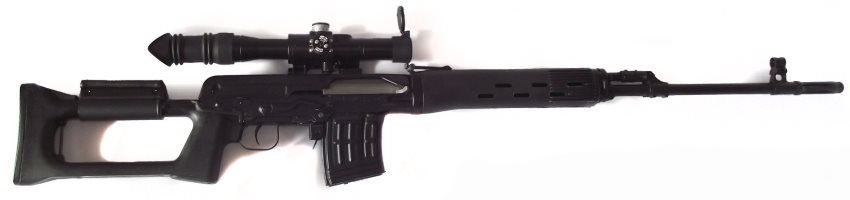
Called and regarded as a sniper rifle, the Dragunov SVD could actually be considered the first DMR, as its role was originally meant to increase the engagement range of a squad of infantry via a- imagine this -”designated marksman” in the squad.
The midpoint between a combat rifle and a sniper rifle, the DMR is designed to tick the boxes of being a combat weapon- self loading, rapid fire, possibly even having backup iron sights (BUIS) -but over a much longer distance. As such, they’re typically rifles with fixed stocks, possibly even ones made for greater shooting precision like the one above, and longer barrels. They’re also typically semiauto only, because one of the things a squad’s designated marksman is best employed isn’t hosing out enemy positions with heavy sustained fire, but rather by directly killing the enemy’s more high value targets. Because while a stationary machine gun position makes a hell of a good Scissors to a squad of riflemen Paper, a couple of good, accurate hits from another squad’s marksman with one of these is a decisive Rock.
NEXT TIME:
The mechanics of firearms- that’s right baby, we’re talking rifle actions. Short stroke pistons ahoy!
Image Credits:
- Horrific Franken-AUG was found at http://sf.co.ua/id11832
- M16 and M4 Comparison photo by Offspring 18 87 (Own Work) on Wikipedia https://commons.wikimedia.org/wiki/File:M16a1m16a2m4m16a45wi.jpg
- All other photos from www.modernfirearms.net