Did you know that your definition of rifle as “a firearm with a rifled barrel” is archaic, and your pedantic insistence that it should be nonetheless applied to defining the role of futuristic directed energy weapons can go fuck itself?
Correct yourself, nerd.
Sometimes the internet is a place where the adventurous can reach in and pull forth something wonderful to share. Sometimes, it’s a source for aggression that has no target with a physical presence in your vicinity and so must be sublimated in more creative ways.
Let’s talk about rifles.
The first known true firearm, which is to say a weapon that uses a direct ignition method on a propellant fuel to accelerate and launch a projectile, were quite literal hand cannons, small cannons designed to be carried and fired by a soldier with a lit match. They started out pretty simple, tubes that looked not unlike ye olde bazookas. Later, some bright light got the idea to mount them on the end of sticks to make them less of a risk to the shooter if they blow up. This is where designs start becoming more and more divergent, such as weapons with multiple chambers for multiple shots, indirect fire weapons in hand bombards that were more akin to modern grenade launchers, and of course, weapons that would adopt the delightfully Chaucerian-sounding “handgonne” as their moniker.
Then early in the 1400s, people start getting the idea to make the stick that makes your gun (or gonne) exploding not kill you so much into a more elaborate sort of deal to aim with. The stock was born, and with it, the first instance of the arquebus that resembles what someone living in the modern era would parse as a firearm. The very earliest of these guns were just slicker hand cannons, that still needed to be hand fired with a lit match. By 1475, however, the matchlock was invented, which used a mechanical trigger to tilt a lit match down onto the powder pan and fire the weapon. This allowed for the first time something approaching our notion of aiming- that is to say, taking up a long weapon with both hands, shouldering it, putting it on target and then pressing the trigger. This was good! What was bad, was that this method requires a lit match and an exposed pan of black powder, which means that these firearms both really required a target to stand still for long time while the shooter set up their shot, and also, good weather to ensure wind or rain didn’t spoil it all before the shot even leaves the barrel.
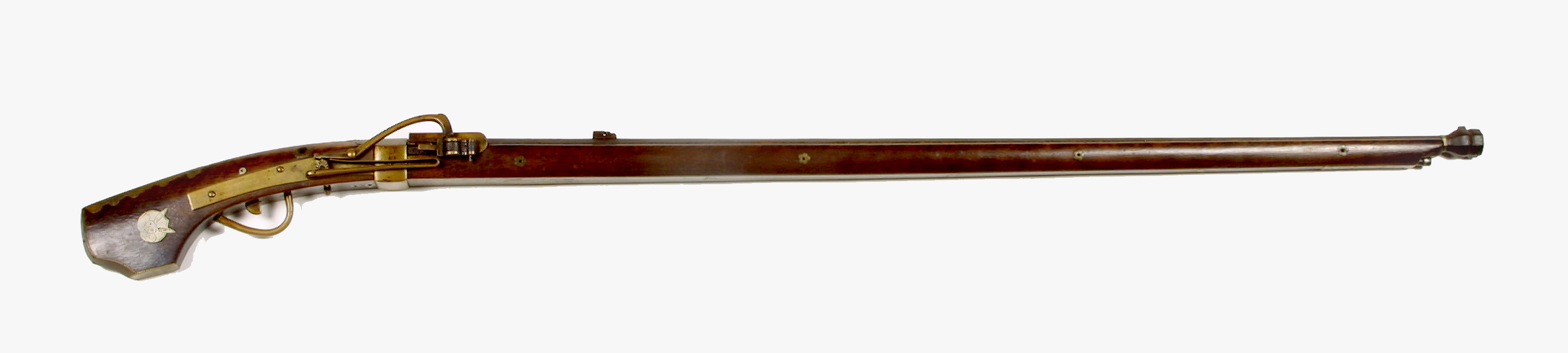
Trade with the Portuguese brought the matchlock to Japan in the 1500s. During the wars of the Sengoku period, the Tanegashima was one of the most, if not the most common firearm on the planet.
Advancements would bring reliability to this basic template. There’s a lot of yadda yadda about to happen here, and for that I’m sorry, but this is a 100 level sort of deal. There’s two big things that happen in this phase. One is the development and wide adoption of the flintlock mechanism, which took the basic principle of the matchlock, and instead employed a flint and striker to create a shower of sparks, which fell onto a powder pan that is covered by the mechanism itself until the last second. This meant a number of things, the biggest being that shooters didn’t require a lit match (or any source of fire) to shoot their weapon, weapons could conditionally be carried loaded with a degree of safety and weather conditions when shooting had become as small an issue as they were going to be in the premodern era of firearms. The other big deal was rifling, which at its most basic can be described as a set of lands and grooves dug into the interior of the barrel, spiraling around themselves in an even, helical pattern. When a bullet is propelled down a rifled barrel, it digs into the rifling, which imparts spin on the bullet. This spin makes the bullet stable during unimpeded flight, thus accurate, predictable and replicable, whereas previously, non-rifled barrels (“smoothbores”) pretty much kicked the bullet out as it was, letting it do what it do on the way to its target. Rifling meant that rather than inaccurate, massed volley fire out of smoothbore muskets (and their shorter versions, musketoons), the majority of which would miss or even fail to reach their target, lethal force could be delivered precisely and often with a single round.

Rifling: Now in Pop Culture Reference Form.
Here is where the donuts are made, because here is where the term rifle really comes into its own. See, rifles were great, but they were also hard to make. At the time they started to see military adoption, they couldn’t be fielded in great numbers- muskets and the like still ruled the day for the regular, dog-poor infantry. Instead, what you saw were rifles being used for smaller, special units, individuals who had more important business than to show up in a line and get shot for the empire. For these individuals, rifles were their most immediate and obvious threat, because they changed the rules of war for the day, taking them from “very dumb” to “still really quite dumb.” See, previously, war was a relatively safe prospect for the nobility and the officer classes, for the simple reasons that guns neither shot far enough to reach them behind the lines nor accurately enough to hit them. This changed with the introduction of the rifle, because suddenly someone with enough nerve and steadiness could climb a tree, tweak their sights and actively free up open positions in the enemy’s officer corps.
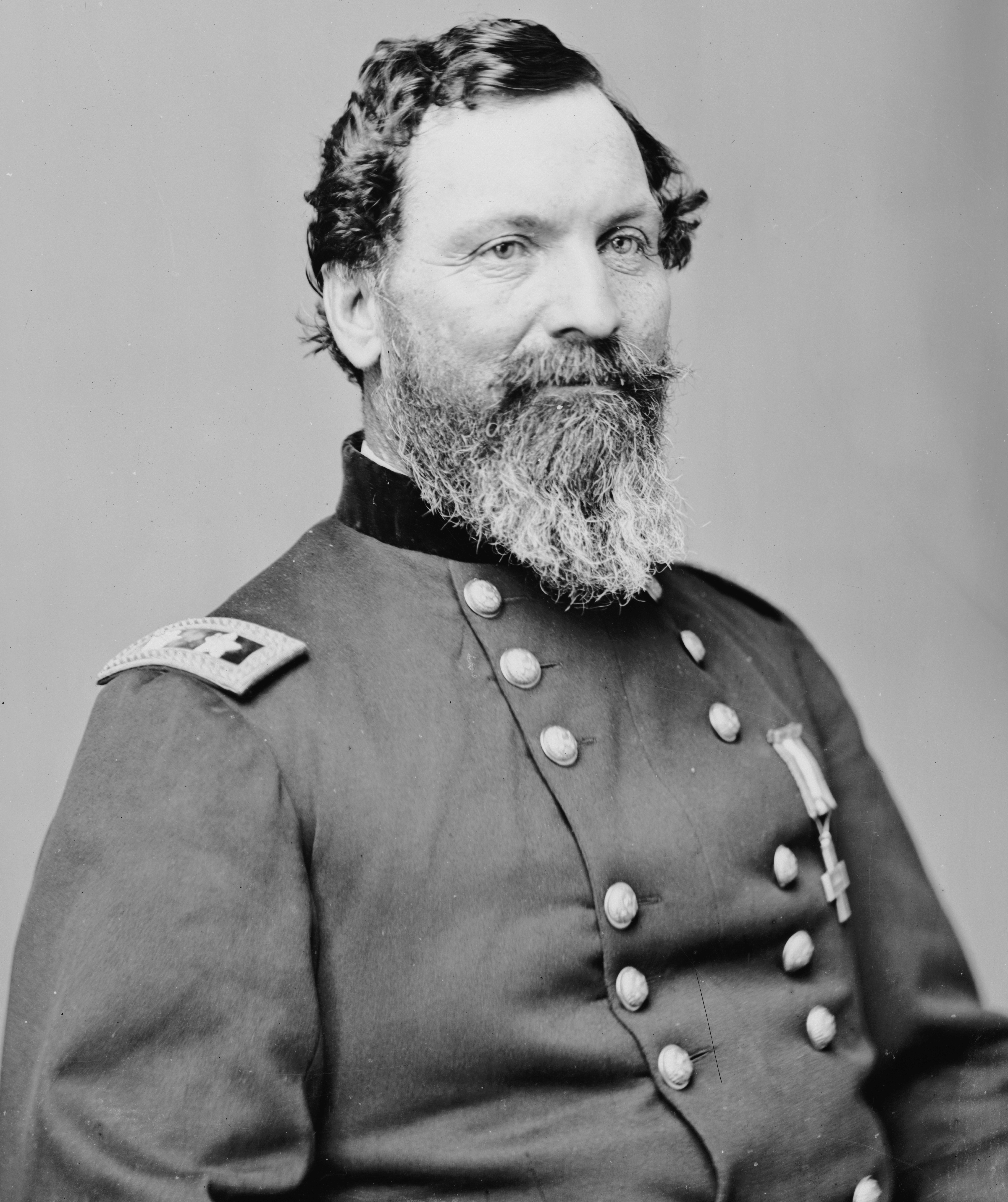
Major General John Sedgwick, Union Army. Born 11 September 1813, Died 9 May 1864. His last words were “They couldn’t hit an elephant at this distance.” He was wrong.
With all this, not to mention the innovation of modern rimfire and centerfire cartridges (and I promise I’ll explain those things better, for now: bullets that have the powder in metal cases, rather than individual musket balls you’ve got to pack in yourself), the rifle becomes known for doing what it’s still doing now. At its very start, the rifle was a weapon that was first single fire, then later, equipped with a magazine to hold multiple shots, thus manually extracted and chambered (“cycled”) by a mechanism driven by muscle power. Further development led to mechanical systems- actions -that both streamlined the process of cycling the weapon, such as the venerable bolt action (World War-style rifles with bits you gotta pull back, then put forward before firing) and lever action (Western-style rifles, with the ratchet handle thing that’s sort of attached to the trigger- Arnold used a shotgun with a lever action in Terminator 2).
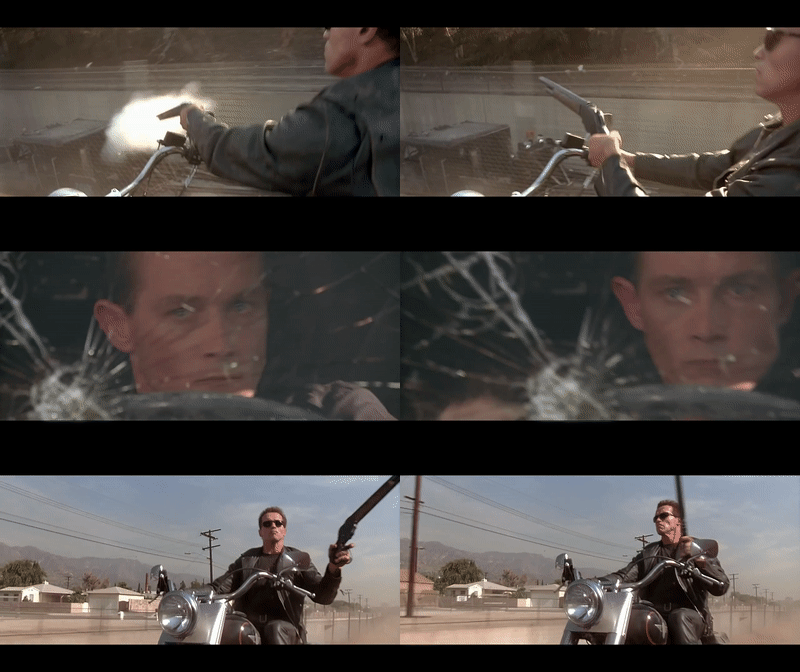
WINCHESTER 1887. YAHOO, COWBOY.
And then past these, in the very late 19th and early 20th centuries, lie the advancements in technology that produced what were then classified as self-loading rifles. Because, well, you shoot them, and then via engineering marvels, the weapon ejects the spent round’s empty cartridge, then chambers the next round in the magazine, readying it to fire without the shooter having to do anything. These are now what we’d call semiautomatic weapons, because that’s what the definition of that means- a weapon that will discharge once for every pull of the trigger, continuously, until it’s empty. Next came fully automatic rifles, which streamlined the complex mechanisms used by the first machine guns into something an individual soldiers could carry. Fully automatic weapons are so called because unlike semiautomatic weapons, which only fire once for each break of the trigger, they fire continuously as long as the trigger is pressed and the weapon still has ammo to burn. In other words, 80s action movies were assured their place in time via this invention. Then after all that came burst fire, which was mostly innovated to give a medium option between semi and auto, or to replace auto so soldiers wouldn’t burn through their ammo at the first sign of enemy contact. Burst fire triggers are really complex and basically make it so that the weapon fires pseudo-automatically for a number of rounds- usually 3 -before the trigger goes dead and you have to release it so it resets and you can fire again. This generally allows greater control of fire, at least in theory- a less confident shooter should be at their most efficient when pumping out a limited volume of fire, given they neither have to be rapid on a semiautomatic trigger, nor mindful of an automatic one.

And now, an early model of the AK-47. We have arrived where we need to be.
The ranged weapon came into being because it provided a simple and powerful advantage for a species that likes fighting each other, but is devoid of natural projectiles other than foul language and expectoration. We started by throwing rocks and spears, the basics, the classics! Then we invented slings and bows, simple machines to make throwing rocks and spears easier, more powerful and with a longer reach. This is the evolution long guns have taken throughout their development: “hey jerks, we can shoot you from farther away!” “oh yeah, well now we can shoot from the same distance away, but faster than you feebs!”
This is what we see now in the modern combat rifle- a weapon system that can make an individual fighter a threat at medium to long range, that is accurate and powerful enough to end a one-to-one engagement in a single shot if possible, but is also capable of sustaining a base of fire (which is military speak for “shooting for a long time at where we know the enemy is, regardless if you can see them or not, so that more mobile fighting elements on your side can do their thing”). That last bit is probably the largest draw for modern repeating rifles as a military standard issue weapon, because with automatic rifles, a relatively small number of people can unleash a lot of spicy bimetal hell on a general area, making it difficult for the enemy to take a safe position to fight back or even move out of the way. This is suppression, and this does all sorts of things, not the least of which is give close air support pilots a nice slow target to drop a bloody great bomb on. Modern warfare!

The French FAMAS. To you and I, A killing implement. To a general? Gorilla Glue for holding enemy infantry divisions in place.
This is why there’s that sting about pedantic usage of the term rifle in fantasy and SF settings. See, rifles do have rifles. So do handguns, so do submachine guns, so do machine guns, so do some shotguns, so do some grenade and anti-armour weapons. That use of the term ‘rifle’ is pitifully outdated, to the point that were you to pull that shit on someone in the know, you’d know you’ve done something wrong by the number of blinks you’d be seeing in your direction without anyone saying any words at you. It’s about the role of the weapon, not a common feature!

Click the attachment below for higher res and GREATER ENLIGHTENMENT.
It’s not hard to tell which end goes toward the enemy, which is enough of a problem in modern armies that they put it on Claymore mines. Still, with someone that understands the basic concept of “gun” could probably fumble their way into putting someone into a hurt locker if they were determined enough. But a lot of folks see a thing every day and not know what it’s called or what it actually does, so it’s time to learn what all the fiddly bits on the side of this thing are. Let’s go top to bottom:
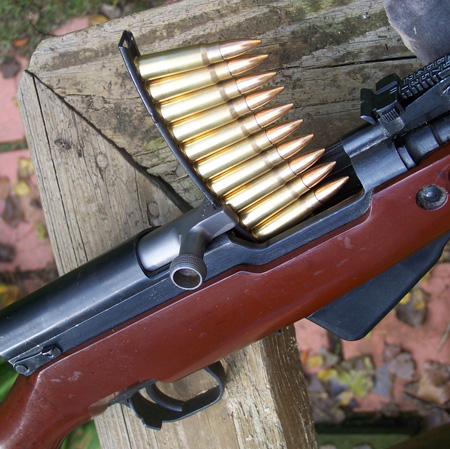
Finally here: what a clip is and what it actually does, demonstrated.
You’ve got what you need to identify a rifle and its parts. You know why they’re used. Next time, we’re going to learn how to use them, different ways of using them and a number of variations on the theme of “throws a big, pointy bullet at high speeds”. See you then!
Images