Monster Essays: Vampires
Added 2020-06-01 20:58:41 +0000 UTC
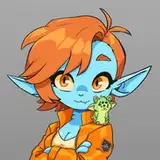
Vampires were a part I definitely wanted to exist in the Ghetto Goblin setting, it just took me a bit on where to fit them in. They basically ended up the same as everyone else in the big picture, but with a huge government crackdown watching over them like ex-felons. No matter how nice a vampire may be, if they’re alive, they’ve bitten somebody. They’re the only species that HAS to hurt someone to live, and are dangerous, strong and fast by nature. That gets a little gray, so most of the ones you’ll find today basically have a parole officer they check in with, a friend or partner they can snack on, and a small fortune from either ancient inheritance, wise investing or abusing super speed and magic. I wrote a recent commission set in the same setting involving a vampire and the politics/stereotypes involved; you can check it at http://www.hentai-foundry.com/stories/user/luffy316/42167/Count-Natalias-Roleplay-commission
Also had a vampire side character who owned The Haunted Rose brothel I still have a half-finished fic for.
Dylan Eywind
History of Interspecies Relations II
Bloodwork. A History of Vampires
**A+. Very thorough use of sourcing. I hope you see why I kept such a complex topic as one of the last**
Vampires remain one of the most difficult and restricted species to be revealed, which may explain why they were among the most recent to unveil themselves. Like werewolves, vampirism is technically a condition that can infect many sentient creatures with proper preparation. The fact remains that while orcs had a violent encounter early on with humans and demons had to overcome the stigma of coming from Hell, vampires are the only race that is explicitly predatory on intelligent creatures. This has led to much more secure precautions being taken concerning their presence.
To start, vampires have few constants to their appearance. After they are turned, a vampire becomes pale with their eyes turning an unusual shade of red or black. They cast no reflections and are undead, magically caught in a state of near death. The turned person will never age and their heartbeat will become next to non-existent. They become incredibly strong and fast with highly enhanced senses, and their semi-dead state opens their perception to raise their potential for magic. They are unable to fly or hypnotize or control animals, as some myths suggest, but these can be learned with their new feel for magic and seemingly endless lifespans. Their bodies possess some level of healing factor (more rapid than goblins but not as potent as werewolves) and their mouths develop additional bones that allow them to open their mouths wider to expose their enhanced canines/fangs.
For all their benefits, vampires experience several weaknesses. Direct damage to their heart or decapitation is still lethal, though doing so is a difficult task at best. Most other superstitions are exaggerated cases from individuals, but the truth remains behind their inability to touch sunlight. Doing so rapidly burns their skin, generating smoke and causing intense pain. This takes several minutes to kill a vampire, but drastically weakens them while causing all but the most experienced into utter panic.
The main stigma remains that vampires are a predatory species. Common food sources provide almost zero nutrition (though they sometimes enjoy it with their enhanced senses) , but consuming roughly one pint of human blood is enough to sustain a vampire for several months. Failing to do so will cause fatigue, weakness, and eventually starvation. Their bodies are clearly adapted to rely on their new fangs as their main means of hunting. Their saliva has a number of helpful effects, encouraging bleeding while the wound is open and rapidly healing the bites once they are done feeding. It creates a mild numbing sensation to confuse their prey, with a few reporting euphoria that may come from lightheadedness.
This is also their main means of spread/reproduction. There are apparently ancient rituals to make someone into a vampire via magic, but the much more common practice is by transfusion. When a vampire drains the majority of a person’s blood, they may share some of their own blood to save the person’s life. Science is so far unable to explain the exact process, but the fact seems to be that vampire blood cells are actually rather weak on a cellular level. This would explain their need for more blood to replace it, and why they would need a victim to be missing most of their blood. Otherwise, it would be quickly consumed by antibodies. Once infected, the body enters a brief death-like state where it goes through its changes before reawakening as a vampire.
This leads to several issues that arose with their arrival. With the increase in magic and awareness of other species, most vampires found themselves unable to operate in the secrecy that they were used to. Many of them presented themselves publicly as vampires in The Midnight Mass, a mass reveal of vampires that willingly turned themselves in to government custody. They were tested to confirm their conditions and understand their biology before various precautions were made.
The government agreed that vampires could not feed freely on other creatures, given the risks that would involve. Every vampire went through a thorough background check before they were granted tentative freedom with regulated feeding. As of today, the process involves the following.
1. Recognize the subject as a vampire. A simple blood test, x-ray or “mirror test” can resolve this easily.
2. The vampire is questioned and investigated concerning their prior activities. Most vampires prefer not to waste a food source and avoid gorging on/killing a target when they can. Some leeway is given in these cases, but some vampires are still serving prison sentences and may be the cause for others to remain hidden. Concealed vampirism is currently a major offense.
3. The vampire is loosely tracked, reporting in to a government agent not unlike someone on probation or house arrest, though free to move about as they please.
4. The vampire is given a regulated pint of blood every 4 months. This serves two purposes; for one, to make sure the vampire does not go hungry enough to resort to more drastic measures. On the other hand, vampires can only contain so much blood in them at a time and process it correctly. If a vampire has been feeding excessively, their inability to eat the pint of blood will lead to detention and further investigation. Some vampires will register friends or partners that sign off as willing “donors,” officially registered administrators for the undead. Most of these issued pints are delivered via sanitary bags (which vampires consider distasteful but edible), but those on good behavior can request a willing donor. Either way, they must feed on their regulatory pint while supervised.
5. Given good behavior and cooperation, the vampire is eventually released from this watch and must only report in for the regulated blood.
Much like dragons, vampires tend to be scarce, widespread and in positions of comfort (if not power). European nobility proved to be a common source of vampires, with a small population that traveled over to Asia and American during the start of the colonies. Given that vampires attempted to remain stealthy while assaulting humans, vampires tended to live in very small and selective circles and converting mortals very carefully. Aggressive, impatient or tactless vampires tended not to last very long and revealing their kind’s secrets was once considered a terrible taboo that was swiftly punished (assuming the humans didn’t get them first).
The stepping down of vampires seems to be a common trend, showing remorse and an urge for cooperation and coexistence. While a few proved to be aggressively against this change, most are quick to share their wisdom, magic and wealth. Calvin Pike, once considered an eccentric heir to a small fortune in Michigan, revealed himself as a vampire while donating half his fortune towards his community. Vampires often describe their condition as a test of character; a trial that they face much like any disease. Elodie Lutemme was quoted in regard to her kind:
“The easily tempted leave bodies. They fail the test. The proper stance is that we, as a culture, must take to survive. It is only fair that we would give something back after so many centuries.”
Vampires continue to spread across the world at a controlled pace, though by their own choosing rather than regulation. New converts are registered as any other vampire, and these modern thinkers and “young” vampires provide a fresh outlook and more cooperative generation for their kind. After this initial unease and precautions, dark parasols and tinted windows are not an unusual sight in any major location. Another set of immortal minds join in our society with new insights and needs, expanding our horizons no matter how many times we believe they have reached their limits.