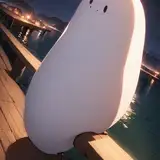
Sea Bunny Studies
Added 2024-03-20 03:59:42 +0000 UTC
The winner was slug! Sea bunnies are nudibranches, which are sea slugs. Which is a bit of a stretch, but I figured it would be appropriate for easter! 🐇
These studies are fairly basic, due in part to the fact that they are very simple and squishy, and a lack of visual references I could find of the more complex aspects of their anatomy.
so I spent a bit more time figuring out how I could draw them, especially how to give the impression of the "fluffy" texture.
FUN FACTS:
- A slug is basically any snail without a shell. The category "slug" is "polyphyletic," which means it includes organisms with mixed evolutionary origins and no recent common ancestor. Many snails have convergently evolved to lose their shells. The same seems to apply to sea slugs.
- There are a few species of nudibranches referred to as sea bunnies, but the Jorunna Parva (The specific species I have drawn here) is known as the sea bunny.
- Their "tails" are their gills. In fact "nudibranch" means "naked gills," and is a feature shared across all nudibranches.
- Their "fur" is made up of little sensory tentacles.
- Their diet consists of toxic sponges, whose toxins become a part of their body, making them poisonous themselves.
- They are hermaphroditic, but cannot fertilize their own eggs.
- As solitary animals with relatively short lifespans (a few months to a year) many never get a chance to breed.
- On average, they are a whopping 1cm long.