I wrote the draft to this post some time ago after being asked a number of times to explain various aspects of what I do, and how. I can only state what I do, what you do is really for you to DISCOVER. My process and techniques have evolved through spontaneous and uninhibited experimentation, if you can call it that.
Things for me have also (importantly) evolved though some very good and collaborative connections with various creative people. I've heard people say I'm lucky because of this. Lucky's a funny word indeed.
"Oh you have a fiance who's an amazing model so it's gonna be easy for you to get stand-out and exclusive images!".

Photo: Shot with the handheld LED light mentioned below.
It is not easy, believe me.
If my situation is advantageous for my photography, I've made it that way. If you want to be as pig-headed, motivated, obsessive and driven as me, then you can also end up in my shoes, but many would not want to be here. If you do, get ready for a wild ride.
I've traded MANY of the usual 'necessities' and comforts of a 'normal' life in favour of my art. So when people say that I'm fortunate that's only because I've allowed that to happen and I've put myself out there in a vulnerable place in order for that to be able to happen. All in the name of my photography.
So I've broken down just a few aspects that I think are personally important to advance my own work as follows (please note this is written from my personal point of view) :
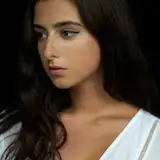
I have two favourite outdoor light motifs. One is what I call Lindbergh light, where the light is reflected into a dark space (could be indoors in a room or outdoors in a cave for example), and I usually shoot it straight on, looking for definition in cheek bones among other things. It’s a flattering kind of lighting configuration where skin really glows and shadows aren’t too harsh. The distance back from the reflected light source is crucial to things like the mood of the image, definition of cheek bones (that's big for me) etc.
The other is backlight, which I use extensively outdoors. It’s not easy to manage this lighting but with modern cameras it’s much easier - via the preview screen in other words.
Over the last 6 or 7 years I've also experimented and used a lot of types of indoor lighting. I deliberately didn't want to use flash or strobes much as everyone does that and I already know all that stuff. The humble desk lamp has become my friend and it doesn't matter where I'm staying, which hotel or AIRBNB, most have some kind of desk lamp available. Desk lamps also give me the kind of lighting that provides more life and more of a gonzo vibe.
More recently I discovered a fluro makeup light that I love (for some shots) and also one of Aurora's togs gave me a hand held LED thing that is very small and compact - he thought it would suit my 'desk lamp' style 😂

Photo: Shot with the fluro makeup light.
The main thing the model needs to be able to do, from my perspective, is to be able to express themselves freely. They need to feel completely comfortable to do this, no inhibitions.
Now this a BIG THING. So of course, it’s up to me to create the atmosphere and vibe where this can happen. I can usually do this, but in the end, it’s up to the model and your personal connection with them. Some models can naturally 'let-go', others will never be able to do it. So of course, how comfy they feel with you is important but also their own personality has to be such that they can show a variety of emotion and feel unhindered doing that. Some models are more extroverted than others but I’ve also worked with models who are quiet by nature yet still have the capacity to freely let-go.
So when I mentioned the stuff about my personal connections with models, this is where that comes in.

Photo: Fran. It's probably no accident that some of the models I've worked best with have been Italian., Italians know how to express themselves! She has also become a good friend outside of photography.

Photo: Flavia, another crazy Italian who became a good mate. Looking forward to seeing her in Australia soon. She doesn't model anymore but seeing her has nothing to do with photography anymore.
Usually, within 10 minutes of meeting a model I'll know if any of this is going to be possible. Often, I can even tell by looking at their portfolio. So this is probably a skill to think about and develop, to be able to quickly determine if your chosen model is going to be able to do what you need to create your style of image, whatever that is. To help this along, your own personal demeanour should be relaxed and cool, motivated, and INTERESTED in your model. Establish conversation/connection before the shoot, establish a vibe between the two of you that each of you can feel comfy in without going over the top and seeming TOO friendly. Be totally aware and alert, read the model, try to get a handle on your vibe with them firstly.

Photo: Alena in Antwerp recently. It was Alena's idea to put the shoe in her mouth. Relevant to what I'm saying about the model feeling comfy to do weird shit. Alena's not usually the kind of model whop'd do this but she obviously felt comfy enough to do it. I just tweaked the pose a bit. Initially she wanted to pose with the shoe model style, but I suggested she just stand there with her hands by her side with a neutral expression. I rarely tell models what to do or direct them. For me, things work much better if the model is initiating the shots.
I'm a portrait photographer. I capture people. So my thinking about my work is that the model needs to give me something, to show me something of themselves. I don't ever say that to a model, but it's what I need so that I can take what they give me and use it in the best way. Of course I can prompt them and help them do this but the initiative must come from them so they really need to WANT to be here shooting with me. They need to want to give me something but I'm not talking about giving the kind of thing that most models give to most photographers, which is the usual model pose thing. Fuck I sound choosy don't I? 😳
I use hair a lot. I like hair. I normally like it to be wild yet still in a certain formation. I use it to conceal the face sometimes, and leave one eye out, and other times just crazy hair indicating a certain rawness or unkept natural state. I love certain looks, such as the hair swept completely over to one side. I also nearly always require volume on top, nothing worse than a flat head!

Photo: HAIR!
The model needs to trust that I will find the shots rather than for them to give me the shots in the usual model way. What I mean is, most photographer-model dynamics revolve around pose, focus, click and repeat - pose, focus, click etc. This dynamic is essentially the model giving the photographer the shots and the photographer just clicking away for each new provided pose or position. An analogy could be a painter, with someone else controlling their hand while they make the brush strokes. This method sucks as far as I’m concerned and means there is nothing of the photographer in the shots. As a photographer, you have to put something of yourself into the shots - but then photography is a very literal medium so this is a hard thing to do.
When the model is in control and providing you with the standard images, they are confident that the images will reflect them in a good way as they are controlling the poses and the angles - they know they look good in certain angles and poses - so they can be fairly confident the images will make them look good. Fair enough, but you need to have such an eye where you know as well as the model knows, what will make them look great. And the model needs to be able to trust you on that. IMO, this is a huge failing of many photographers. I see tons of work from other togs, via Aurora of course. Example: you may have trouble seeing proportions correctly and the model ends up looking like a midget because your camera angle was both too high and probably tilted down, or, the lens was wrong (this is easy to get trapped on as your vision can be tricked by looking through a small viewfinder). If you fuck up here with the midget look then use the geometry controls in your software to try and fix it. Many shots can be fixed like this.
Each model has their own individual proportions that look can look pronounced or different to a camera. It's up to you to quickly assess their proportions and how the camera is seeing that. Then and only then can you go about shooting them and being sure they'll be OK with the shots. If they're not, then they will never feel fee enough to express themselves in a way other than going from pose to pose, click, pose, click, pose ad infinitum. I totally understand and empathise with a model who doesn't trust the photographer to be able to capture them properly when they're not going through their usual posing routine. Having done a reasonable amount of modelling myself I'm very aware of areas where I know I'm going to look terrible. I mean there's degrees of terrible. I don't look great any time but there are degrees of not looking great!
Ideally, the model is not so much posing, but freely moving - through a range of expressions as opposed to going statically from one shot to the next. Some people call it Flow Posing. Many models have already developed ways of doing this so that they still ‘look good’. For me as a portraitist though, my attention is usually on the face and top half of the body so I usually suggest some ways of moving that I like - moving the hair across the face, hands, facial expressions etc. and I'll demonstrate that to the model. Sometimes it takes the model a little while to ‘get free’ and start moving in a way that I like. I shoot as they move, usually on digital first, until things start looking right, to me. Once things are looking right, I usually move to the film camera, either 35mm or 120. When I recognise a ‘look’ that works for me, I’ll let the model know and we often tweak that position of expression to the best advantage. Then we move on, more movement…. There is no repeating anything, it’s a continuous process.

Duos (and especially trios!) are an excellent test of compositional skills on the move. While allowing the models complete freedom in how they interact you need to be on your toes and moving, grabbing frames and making compositions that work, at the same time. I highly recommend this to any photographer. Pictured are Eva Lunia, Romi Muse and Aurora in Barcelona 2019.
Having talked about models flow posing I would also mention that if that's a routine they've worked out before then it might not be good enough for what I'm talking about.
The above works for a whole range of shots, from moody portraits to wild movement and full body shots.
For example, on occasions when I've worked with another photographer shooting the same model doing essentially the exact same thing in the same light - the images the other photographer ends up with are very different from mine. Try it and you'll see. That’s because no two photographers will hit the shutter at the same time. Why? Because each photographer’s vision is different. What looks good is different to each photographer, what MOVES YOU is different. What I look for and what I think best reflects what I want to say will be different from someone else’s.
It's a certain ‘edge’.

Photo: Sophia in Sydney. Sophia's body language and personality vibed with me from the word go. These shots are very much me and they also demonstrate what I'm saying about timing as neither statically posed. The one on the left was taken as Sophia was walking dow an alley in the chosen light.

Photo: Fran in the same Sydney alley as Sophia but 4 years later 😄.
It’s very hard for me to put language around this. It relates to a certain expression. Other words might be: pride, confidence, sexuality, nature, mystery attitude. Many expressions will reflect these things. It might not be the expression, it could just be the composition of body parts in the frame or the context, the background elements. I can’t put language around this, it’s far too intuitive and related to my own personality and expression.
But in the end, this is your voice, your artistic voice. So, try to shoot what moves you, shoot what you want to say. Do you have anything to say? That's a good question because if you do then you can shoot it and your shots will be you.
Good luck!