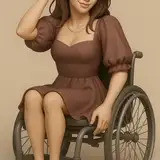
The Wheelchair Diaries - Chapter 12
Added 2025-09-03 13:14:22 +0000 UTCI wake up to the dent in the pillow where his head was and the glass of water he left exactly an arm's length from mine. The flat is the kind of quiet that makes you hear the heating tick. For a few seconds I just lie there and check the map: shoulders fine, arms working, hands present. Abs soft, a slow sway under my ribs. Everything below, silent.
T6 is still here. Deeper than yesterday. My torso feels like someone loosened the screws in the middle of me.
There's a note in my texts:
Ben: Left early. You were asleep and smug. Water by the bed. Be kind to your body. Text if you need me.
I smile at "smug," then I move and prove him right: even the act of propping myself up is a negotiation. With T10 I could cheat with a little hidden core; T6 makes me earn every angle. I hook my elbow, push, and my hips just... follow when they're ready. There's no pretending.
The diaper is heavy. I don't feel it, obviously. I just know, the way the waistband sags under my fingers, the faint give when I press. The blue line is gone. Real life, real body. Yesterday I thought that would embarrass me. Today it's a fact to manage.
"Okay," I tell the room. "We're doing this."
The wheelchair is where I parked it, rigid frame snug against the mattress, brakes on. The diaper kit is also exactly where we left it: wipes, powder, a fresh one slid under a folded towel. I roll onto my side with arms only, the way we practiced: one hand a brace, one hand a lever, breath out on effort. It's clumsy and I'm already sweating.
Tabs, wipe, wipe, patience. I work methodically because chaos in this context is a bad joke. The used one makes that soft, defeated sound when it leaves me. I clean without rushing past it. Fresh diaper under with a papery whisper, front up, smooth, tape. The left tab fights me (of course the left); I redo it. When I'm done I lie there for a beat like I just finished a 10k, which is funny in a way that almost makes me cry.
Dressing like this is... a sport. I decide on jeans because I want the silhouette, and also because the battle is part of the point. They're a size up, room for the diaper. Getting deadweight into denim is a process: socks first, then slide a leg in, catch the heel on the hem, stop, back the fabric off, try again. Under-knee lift, boot guided through, tug-tug-tug. The second leg is worse because I get cocky. I end up with one knee through and the other heel hooked like the jeans are trying to keep me. It's funny until it isn't; then it's funny again.
Waistband is a whole other problem. No bridge, no helpful core. I do the lean-and-pull: tip to the right, pull the left side up; tip to the left, pull the right. My middle protests by turning into warm jelly. I anchor one hand on the mattress and work the button with the other. It takes me three tries and a swear word I aim at no one.
On top: a white camisole because the cardigan needs a base. The green cardigan is soft and a little oversized; it reads gentler than a blazer, softer at the waist where I'm softer now. I thread my arms one by one, and even that is a lesson, don't lean forward when your center is unreliable. Keep one hand on the mattress. Breathe. When the knit drops over my shoulders, I feel more like a person and less like a project.
Back to the chair. Feet back to the fixed footplate. I roll to the mirror. The jeans help. They carve a line I like, disguise some of the lingering muscle that feels like a ghost of somebody else. The cardigan covers the tidy flatness of my stomach that I still don't trust. My legs sit exactly where I put them, passive, feet angled outward on the single plate like punctuation.
Coffee is a puzzle I feel ready to solve. The lip into the kitchen is behind me, I pop it with a breath out and an elbow ready to save me. Today the wobble is louder, today I listen. Kettle to the edge (don't overreach), mug within reach (anchor), pour (breathe). I bump the rigid footplate on the cabinet kickboard and hear the clean hollow knock. No sensation. Just sound. I like sound.
I text him between sips.
Me: awake. still jelly under the ribs. changed, dressed, alive. Jeans: 1, me: 1.
He answers fast.
Ben: That's a draw in your favor. Eat something. Be nice to the lip. Proud of you.
The "proud" loosens something low in my throat. I bite a piece of toast and it tastes like a reasonable person's morning, which is not the same as ordinary. Every reach is a tiny risk. Every push a reminder. When I angle for the fridge and overcommit, my torso pours forward and I catch the counter with the heel of my hand and laugh alone in my kitchen like a maniac because the correction is clean and mine.
Back at the mirror to check the aesthetics before I leave: green cardigan, white camisole, jeans that mean business, hair in a clip that will fall by noon. My thighs are still stronger-looking than I want, but the denim hides it. I rest my palms there, not to feel, because I won't, but to remind myself these lines are for me.
For a second the countdown sneaks in. Tomorrow, maybe the next day, this will wear off. The hush will lift. My legs will take opinions again. The thought is a small, mean knife. I let it sit on the counter. I don't pick it up.
I put my pair of red platform converse on and slide my backpack straps through my arms one at a time, lean back into the backrest until the sway calms, and set my hands on the pushrims. The chair hums on vinyl, the rigid plate whispers, the heel loops do their little quiet job. My world is smaller and more precise this morning, and I like it.
At the door I text him again:
Me: Corner shop after work if it's still here?
Ben: With me next to you.
I lock up, breathe out, and push toward the lift. Gravity is louder. So am I.
I get to the gallery early again, the light still gray on the big windows, and no one says anything. Which is almost a relief. The paralysis is humming under my ribs like a quiet engine and I keep waiting for someone to squint at me and go, Huh, something's different. But the world is itself: printers whining, a courier arguing with security, a meeting room door already half-shut for a thing I'm not invited to. Liv waves a scarfed arm from across the floor, Steph mouth-shapes "later?" around a marker cap. Ordinary carries me along like a lazy river. The wheelchair feels heavier on the carpet than it did on my flat's vinyl. I lean back more when I push, conscious of the way my abs gives if I forget.
Two hours into payroll emails, a pen rolls off my desk. It doesn't just drop, it goes on a little journey, caroming off the cable tray and ending up at a diagonal under the desk, just out of reach.
"Of course," I mutter, and wheel in closer. I could ignore it, but the petty part of me wants the victory. I'm new at T6, I want to prove to myself I can live here.
Rule of one, Ben's voice in my head: one hand moves, one hand anchors.
I anchor... for about a second. Then I ignore myself. I've already got my left hand on the arm of the desk, so I twist and reach with my right, threading it under the cable droop. The pen glints beyond my fingers.
I let go of the desk with my left hand to get a better angle. That's the mistake. My torso pours forward faster than I planned, a soft-fold surrender. I try to correct with abs I do not have. Gravity laughs.
The chair tips forward just enough that the front casters catch on the carpet seam. My hips slide, my stomach hits the edge of the cushion, and then my whole body slips out in the world's slowest spill. Boots leave the plate with a double thud. I land on my hands and one hip with a breathy "oh," not pain, just surprise, then roll onto my side because my middle won't hold me in any other shape.
The rigid frame goes crooked beside me, one rear wheel still spinning politely, the single footplate glaring up like it can't believe I betrayed it.
Everything goes loud and then very quiet.
"You okay?" someone says, too near. "Jess?"
I look up at a forest of knees and tote bags. Liv is suddenly there, kneeling in that way only people in dresses can pull off, palm warm on my upper arm.
"Hey," she says, soft but crisp, like she's been waiting her whole life to be useful. "Hi. Breathe with me a sec."
"I'm fine," I say, automatically, which is hilarious. I am on the carpet like a toppled coat stand. "Lost my balance. Stupid."
"It's not stupid," she says. "Do you want help up?"
"Yeah," I say, and my voice does the small thing it does when I hate that I need help and love that help exists.
Callum from ops materializes with the particular competence of people who get paid to move crates of fragile things. "How can we help?" he asks, not grabbing for me, thank God. "Tell me what you want us to do."
"Brakes first," I say, pointing with my chin at the chair. "Pull it close, parallel to me." He does, quick and precise, snapping the brakes down with a sound that's weirdly reassuring. "My feet, can you put them back on the plate after?" I hear myself giving instructions like a person who does this all the time and want to laugh and cry about it.
"Got it," he says.
Liv squeezes my shoulder. "Do you want arms or legs?"
"Arms," I say. "If you can... under my armpits, but more like around the back of my shoulders? And Callum, if you can help my hips. On three, I'll push with my arms a little. Don't lift me up like a sack, just... guide me."
We choreograph it in the air like a heist. I plant my palms on the carpet, elbows already protesting. Liv slips her hands where I asked. Firm, careful, not hauling. Callum crouches near my thighs, hands at the denim where my hips meet the floor.
"One," Liv says. "Two. Three."
On three we move as if we've rehearsed, and for a second it feels... good. My torso is a hinge, my legs are cargo, and the chair is exactly where I left it. I push, they guide, and we get my hips on the cushion with a soft, ridiculous thump. My trunk wants to fold, Liv's hand is a wall. Callum scoops each leg without ceremony, under-knee lift, feet on footplate.
I'm upright. Breathless and red-faced, but upright.
A few more faces hover, someone from Curatorial I don't know well, the new freelancer with the overactive laugh. Steph appears in the doorway, eyes wide. "Everything okay?"
"I lost a fight with a pen," I say. It lands better than I deserve. A ripple of polite laughter. My heart climbs down from my throat.
"You sure you're alright?" Callum asks, stepping back but still in range.
"I'm okay," I say, and I am. No pain. No bruised dignity I won't survive. Just a wobble under my ribs and a wobblier feeling in my chest that has nothing to do with balance.
Liv's eyes search my face for a beat longer than anyone else's. "Do you want to go to the loo? Sit with me a sec?" she asks, sotto voce.
"In a minute," I say. "I'm... actually fine."
People disperse because offices are good at pretending extraordinary things are ordinary. Liv stays, crouched at wheel height, one hand on the side guard like she's petting a nervous animal. "Hey," she says, quieter now. "You handled that like a pro."
"I handled that like a toddler who ignored a basic rule," I say, and we both smile.
"Everyone drops stuff," she says. "Next time I'll get you one of those grabby arm things from Facilities. It'll make you look very authoritative."
"A reacher," I say, the word making my mouth twitch. "Yes, please. Add it to my brand."
She squeezes the side guard once, a little goodbye, then stands. "Text if you want tea," she says, and drifts away like she always does, trailing a ribbon of color.
I sit still for a long minute, hands in my lap. The chair hums when I shift. My feet are neat on the rigid plate, exactly where Callum placed them. Inside, everything is two feelings braided tight: humiliation and a thin, undeniable ribbon of relief. Visible helplessness. A thing I've wanted in theory, suddenly, completely present at my desk on a dumb Thursday.
I text Ben because there's no one else I can say this to.
Me: dropped a pen. forgot the rule of one. tipped out of my chair like a tragic clown. liv + callum got me back in. mortified. (also weirdly... validated??)
The dots come fast.
Ben: Are you hurt?
Me: no. only pride.
Ben: Proud of you for asking for help out loud.
I rest the phone under my keyboard and sit with that. Asking out loud. The sentence I've been resisting for years. The room returns to itself: a printer jams; Steph swears affectionately at a spreadsheet, someone somewhere is microwaving fish because there's always one.
I roll forward, glance down at the pen under the desk, and laugh. I leave it there. Let it be a little monument to the rule I broke and the body I'm learning. At lunch, Liv swings by with crisps and no comment. We sit by the window and talk about nothing for five minutes. On the way back, she points at the floor by my chair, conspiratorial. "I got you a grabby arm," she whispers.
"Hero," I whisper back.
In the afternoon an email pops from Health & Safety about "incident reporting," and I fill it out with a dignity I earn line by line: No injury. Equipment functioning as intended. User error: overreaching. Mitigation: training, reacher, colleague assistance plan. It feels absurdly adult. It feels correct.
At four, I catch my reflection in the black glass of the switched-off meeting room. Green cardigan, jeans, hair threatening to escape its clip. Boots obedient on a single plate. The wobble still there if I test it. No one noticed the difference until they had to. Part of me aches at that. Part of me thinks: good. It means I get to decide when to name it.
On the way out, I pass the spot on the carpet where I met the floor and touch my chest, right where his hand always lands. Anchor. Then I push for the lift, a fraction slower, the rule stitched into my hands: one to move, one to hold.
Liv catches me at the lifts just as the doors slide open, a paper bag of crisps tucked like a secret under her arm. She tilts her head toward the glass entryway where a tall shape is waiting, hands in pockets, messenger bag strap cutting him in half.
"New boyfriend?" she says, eyebrows up, voice pitched to tease.
I make a face that tries to be casual and fails. "A friend," I say, which is technically true and also not the whole truth at all.
"Mm." She grins. "A friend who looks at you like you're a limited edition."
The doors open. I roll in. "See you tomorrow," I say, and she salutes me with the crisps like a tiny flag.
Ben is outside in the kind of London evening that can't decide if it's spring or punishment. He's half-smiling already, scanning me the way he scans everything, quick check of ankles, knees, the line of my torso, then my face, like the data lives there.
"Hey," he says.
"Hey." The word lands exactly where I want it to.
"How was your day?"
"Besides my fall? Uneventful."
He winces in sympathy, then softens. "You okay?"
"Pride: bruised. Body: fine. I have a reacher now, which is apparently my brand."
"Excellent," he says, like I've acquired a prized tool. He steps to my side, not in front, not behind, next to. "Corner shop?"
"Please."
We set off at an ordinary pace that feels like an achievement. The pavement is uneven and the chair sings it to me, small vibrations through the frame into my palms, information I can actually use. A woman with a tiny dog glances down, then up, then away, two teenagers divide to either side of us like we're a small parade. No one stares. Or if they do, it doesn't stick.
At the curb ramp of the first crossing, he glances at me, waiting for the cue. I line up, plant my hands, breathe out, pop the casters. The little bump lifts me just enough that my middle wants to pour forward, his hand is there, not gripping, just open at my sternum like a reference point. I ride down the far side, wheels whispering over the paint, and laugh under my breath because every inch feels both new and inevitable.
"You're getting obnoxiously good at that," he says.
"Please don't encourage my hubris," I say. "It's already filing for not-for-profit status."
The corner shop door is one of those stubborn old ones that pretends to be light and isn't. Ben slips in first and holds it, I roll through sideways with the practiced wiggle of a person who refuses to leave a shop just because it was built before ramps were a thought. Inside, the air is the particular refrigerated mix of herbs, newsprint, and sugar. A tiny bell admits us like a shrug.
He grabs a basket and hooks the handle over his forearm. "Spanish red?" he asks, because he's learned that where I'm from and how I drink are connected in my head.
"Rioja," I say, pointing with my chin at a shelf that has a dozen versions of my adolescence on it. "Something that tastes like dusk."
He grins at that but doesn't tease me for it. We park by the bottles and I read labels while he bends to the low shelves I can't reach without turning myself into a cautionary tale. He pulls a crianza, holds it at my eye line. I shake my head, point. He swaps it for a reserva. Better. He lifts another, Tempranillo with a label so earnest it makes me laugh. We pick two because I can't decide, and because the future feels short and generous at once.
"Anything else?" he asks.
I want to say forever, but that's ridiculous, so I say, "Olives. And those crisps a nutritionist would judge me for."
He loads the basket like we've done this every week of our lives. I do the tiny domestic things I can do without tipping, open the chiller so he can reach, hold the basket steady while he tucks the wine sideways, nudge the chair in tight turns without sacrificing knees to the wire displays. Twice I overreach for fun-size chocolate and twice his hand taps my shoulder, a metronome reminding me where the edge is. The third time I catch myself. It feels like a win I earned.
At the till, the man behind the counter says something about the weather you can only say if you've survived twenty winters here. I laugh in the right place, pass my card, try not to faceplant while I put it back in my wallet. Ben waits until I'm done before taking the bag; he doesn't swoop, which makes me want to kiss him in gratitude and also write him a thank-you note for understanding how dignity works.
Outside, the air has shifted darker-blue, the kind of evening that looks painted. We don't hurry. He carries the bag by the loop, the wine bumping softly against his leg. I push alongside, listening to the regular little scrape of my shoes on the footplate whenever the pavement gets rough, a sound I've decided is proof of life.
"You look happy," he says, not smug, just noticing.
"I am," I say, surprised at how easily it leaves me. "I mean, I fell out of my chair today in front of half the payroll department and I'm still... happy."
"Because?" he prompts, affectionate.
"Because it felt real," I say. "Because I asked for help and no one made a poem about it. Because I went to a shop and didn't feel like an imposter for once.'
We stop at the crossing, wait for the green man. He shifts the bag to his other hand and bumps my shoulder with his knuckles, the gentlest nudge.
"Also because my feet are scuffed in exactly the right place."
He glances down at them, then back at me, eyes warm. "They are."
The light changes. I pop the casters again and he is there in my periphery, matching my pace, no fuss. Halfway across I realize I'm not thinking about the countdown. Not thinking about Sunday. The happiness is shockingly unqualified.
At my building, he opens the front door with a hip and we navigate the lobby's bad geometry like a duet. The lift mirrors our faces back to us: him tall and reassuring, me a little flushed, cardigan sitting kind at my waist, legs placed with deliberate care on the single plate. I look like myself, finally, in a way that isn't about performance. I look like the person I've been trying to catch up to.
"Wine first," I say when the doors open. "Then I'll impress you by not setting anything on fire."
He laughs. "High-stakes Rioja."
In the flat, he watches me move like he's cataloging tiny miracles. I feel it, freedom threading through the ordinary. I did a whole day in this body: fell, asked, learned, rolled to a shop at dusk and chose a bottle from home. No one asked for proof. No one told me to be grateful. I just was.
He reaches past me for the corkscrew, and I let my shoulder lean into him because I can. Because I want to. Because happy and free is exactly this: the steady hand beside me, the open bottle, the shared quiet, the hum of the chair on vinyl, the glass catching the light like yes.
He pours just enough. While the wine breathes, he taps the back of my chair with two knuckles. "By the way," he says, casual-cautious, "if you ever want to go higher... we'll need to talk new wheelchair."
I look over my shoulder at the line of the backrest: low, clean, the silhouette I chose because it looks like the girls I have always wanted to be had. "Talk wheelchair how?"
He takes a sip, searches for plain words. "Your TR is built for independence with good trunk. Low back, no handles, lots of you doing the work. If we aim above T6, T4, even T1, your balance changes. You'll want more support. A higher backrest. Maybe lateral support. Anti-tips, at least while you're learning."
Anti-tips makes me want to laugh and hide at the same time. "So... less sleek. More... forklift."
He smiles, not unkind. "More safe. More comfortable. It doesn't have to look medical. There are good setups, higher backs that don't scream hospital." He gestures lightly along the top edge of my current backrest. "Think an extra few inches here, a deeper contour, something your ribs can lean into when your core taps out."
I take a sip to disguise the flicker behind my ribs, excitement laced with vanity and fear. I chose this chair because it looks like the photos that taught me how to want. Low back, open shoulders, clean lines. I imagine a taller shell in its place and my stomach does that small traitor flip: less elegant; more obviously disabled; closer to the picture I've carried since I was fourteen. The two truths joust in my chest.
"You can swap a backrest. But if we're really going higher, we'd talk to a seating clinic. Get you measured for something that fits high-level balance. Try demos. There's no prize for suffering through bad support."
I look down at my jeans, "I don't want to look like I need help," I say, and then I hear myself and wince. "That's not it. I mean... I want the look to tell the truth, not the costume. I don't want the gear to shout louder than I do."
He leans against the counter, close enough that if I tip, I'll meet him, not the floor. "Then we pick gear that tells your truth," he says.
I make a face.
"Look, I get that aesthetics matter. They matter to me, too. But safety buys you freedom. Freedom buys you the life you're trying to live."
I roll back from the counter a few inches and study the chair in the kitchen light: the low back, the narrow pushrims, the single plate catching my boots just so. It is beautiful. It is also a promise written for the body I had last month, not the one I keep inventing.
"What would higher feel like?" I ask, voice smaller than I intend. "Not theory. You."
He thinks. "More reliance on your arms and the backrest to hold you up. Faster fatigue in your torso. You'd tip forward if you forget. The right back catches you before the floor does. And" He meets my eyes. "there's a kind of relief in letting something hold you."
We carry the wine to the sofa because that's where this conversation belongs. He sits first. I line up the transfer: palm to cushion, palm to seat, inhale, exhale, ride the wobble into his steady hand at my sternum and land a little crooked. He does the under-knee lift, feet back on the floor, knees adjusted by degrees until the mirror across the room gives me back a line I recognize as mine.
"So," I say, when the room settles. "If, not when, if. We go higher. We try T4 someday. We talk seats and backs."
"And we practice," he adds. "Floor-to-chair. Uneven pavements. Reachers. The boring things that make the beautiful things possible."
"God, you're so sensible," I mutter, and he laughs.
He looks at me for a long beat, expression softer than his words. "You know," he says, tapping the backrest again, gentler, "I like this chair because you chose it. And I'll like the next one if you choose that, too. Not because of what it says about disability. Because of what it says about you taking yourself seriously."
The sentence lands in the part of me that still thinks I need permission. I feel my middle sway and let it, shoulder finding his arm without apology.
"Okay," I say. "Not today. Not tomorrow. But... someday. I want to try higher. And if that means I look more... obviously disabled, then maybe that's the point."
"Someday," he echoes. "One decision at a time."