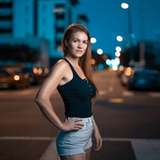
I may have used this photo but I do not think I talked the photography aspects of it. These photos were taken minutes apart. This illustrates the beauty of shooting with intent vs just shooting a snap shot.
I'm not saying these are the most amazing shots, but it gives you an idea of photography fundamentals. So I'll talk quickly composition, lighting, posing, and narrative:
First: Composition, one of the biggest signs of an beginner photographer is a bad composition, particularly the horizon. I remember a mentor teaching me photography when I was starting out. He said "No the rules to break the rules" meaning get creative but there are some fundamentals you should not ignore. Keep your horizon straight, your subject framed either centered or on the thirds, (there are many other framing techniques). Lastly, keep distractions away from your subject. You can see the photo with steph with her bathing suit on, there is a wooden beam directly behind her, which is distracting the viewer's eye from immediately distinguishing her as quickly as if it were not there.
 you can see here Steph is centered, the edges and horizon are straight. If you are shooting handheld getting your angles and framing right is a combination of in camera and post editing.
Next is lighting: Using the two photos above again, you can see the nude photo of Steph incorporates the use of lighting making the image more dramatic. By shaping and controlling light we can make for a more defined subject that "pops" rather that the more flat image where she blends into the background . Here I used a strobe, but you do not need a strobe to get drama. You just need to understand where your light is coming from and find ways to modify or control it. That's why I always love photographing by a window in a dark room. A window on a sunny or cloudy day alike makes for a great light source . In some cases, you can't control it, say, noon on a bright sunny day... in that case you'll just have to embrace the harsh light and make it work with a different style.
 Here is a natural light shot, using the covered patio as a negative fill and the sun (cloudy) as my light source.
Alright lets move on to posing... this is my weak area, fortunately Steph has worked with many other models, been to model posing clinics, and learned a few tips on social media... but in my opinion she is a natural... Sometimes she may seem too stiff or awkward with her posing, but I love that because at the end of the day she is just a regular woman posing for me for fun.
 I can't talk to much about posing, but here is what I will say. Posing your model with the light source in mind is very important, ensuring the pose puts the subject in an area of comfort is also vital. I would also judge the type of shoot and the message you are going for. This pose above for example, illustrates a woman, posing comfortable by the pool. If I had her do some weird high fashion model pose, it would look awkward and be a distraction to the viewer. It would also give off a sense of "trying to hard". Plus in my opinion Steph doesn't look right doing high fashion model vogue posing... understanding you subject and their look and capabilities goes a long way. So I always have Steph do simple, elegant, poses, that highlights her form and beauty.
Lastly the narrative... This is the "why?" if you can attach to the photo or a gallery the why or the reason behind the shoot in form of a narrative, it is and added bonus.


 Here are a few photos from the gallery that in a way help get the point across. Of course the story or the narrative may vary depending on who is viewing the gallery. But if you are shooting with a story in mind, chances are that story will rub off on the audience. In the actual gallery ( you can go back to review) we see a woman, maybe on a solo vacation, who comes back to her small beach house, showers off, and skinny dips in the pool. I always like to get one photo of the area we are in. Maybe a wide shot of the hotel, the landscape, or even an aerial shot.
 Anyway, in summary, shoot how you want to shoot but keep in mind some fundamentals. Also do not let anyone fool you and say gear doesn't matter. A good portrait lens is a must... you do not have to get the most expensive one as long as you have one (for portraits) I always recommend the $99 Nifty 50mm 1.8. I hope this has helped inspire or at least given some insight into how I work.
Paul Modica
2024-05-08 20:02:43 +0000 UTCPatrick
2024-05-08 19:39:48 +0000 UTC