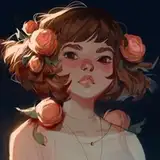
This month, I decided to put together the process video for my Roses painting! I got so many replies on that one, including from artists who wanted to implement some of these techniques into their own work. Hopefully this will give some insights!
Here’s some information about the process videos:
It has been sped up by 200%, so 2 times the original speed.
This painting session took me about 4 hours, split up into two drawing sessions.
I mostly used the hard round brush from my own brush set to paint this. I also used a ‘soft smudge’ brush to soften the edges. I got this brush from Yuming Li’s set that I got when I signed up to their Patreon.
This is painted in Adobe Photoshop. You can replicate a similar workflow in Procreate, with the exception of the gradient tool and the number of layers used!
I also recorded some of the process with my phone to create reels / tiktok videos from. I compiled those together as well - I’ll be posting that after these two process videos!
Here are some helpful resources that can help understand this process in more detail:
Resource // drawing plants: This is the challenge resource video for the plants challenge, in which I chose to paint round, pink roses very similar to these. In this video, I run you through my full process and talk about which design challenges were involved.
Tutorial // stylizing trees & plants: In this tutorial, I talk about how you can divert from a reference image to create a stylized interpretation of a plant. The demo also runs you through how I paint a rose.
FIRST STEPS
My process begins with just making a quick sketch and blocking in the base colors. I knew I wanted the roses to have a warm tone, and the leaves/stalks to have a cooler tone - so I just start with red and blue. Then I soften and blend the tones with gradients and color modification tools until they start to feel more gentle and harmonious. After that I add some shading by creating a clipping layer set to multiply: this allows me to block in some shadows and darker tones that I can adjust and modify so that it blends well with the colors underneath. When it comes to colors, I always find it helpful to just toss some colors down and see where they take me. It’s so much easier to see them in front of you and make adjustments from there, than to overthink the color scheme in advance. That’s why I like to move quickly!
MAKING THE WARM TONES POP
When it comes to warm tones, I often feel like less is more. I want the roses to really have a warm glowing effect, which is something that I try to achieve by giving them a pink hue. However, if I make the roses too pink, it somehow loses its impact and feels overwhelming or obvious - the warmth doesn’t really seem to glow as much. That’s why I decide to change the colors a bit. This is something that I do at 14:41 minutes into the video: I select the roses, copy/paste them onto a new layer, and desaturate that one layer. I use color balance to give these greyish roses a more bluish tone, and then use a mask to bring back the pink in the centers only. I feel like that makes the warm tones stand out so much more, and also has the added benefit of blending the roses and the stalks much more nicely!
RENDERING CHALLENGES
At 40:34 minutes in, I’m pretty happy with how these roses look. There’s a nice blend of clear, sharp silhouettes and softer blending. It’s time to finalize this drawing and render it! This is always such a challenge for me, since I tend to lean into rendering styles that don’t really do justice to my rough version. That’s exactly what happens here: I decide to finalize these roses with a painterly effect, using my hard round brush to zoom in and gradually create more definition. Up close, I like how this looks - but from far away, it’s becoming too sharp and defined, and losing its softness. That’s why I decide to throw away this version of the roses and start fresh, which is something I do at the beginning of Part 2!
That video is coming right up - check out the feed to see it!
Michael H
2025-07-25 12:10:26 +0000 UTCMichael H
2025-07-25 11:31:13 +0000 UTC


















![[_]](https://nokimo.com/istorage/83660.jpg)