The attached zip contains updated keys for Castle Blackmoor.
BLANK TEMPLATE: This file is a blank template for stocking the dungeons of Castle Blackmoor. It includes the first seven levels, with a table including spots for Protection Points, Creatures, and Treasure/Notes. When I stocked the dungeon, I did three passes:
It stops at Level 7 because that’s where Arneson’s guidance for protection point budgets stopped. I’m not certain whether it makes more sense to continue increasing the point values at higher levels or allow them to plateau at 50 x 1d10, and I figured putting the current material into play might help elucidate the matter. (So we’ll see where that leads us the in future.)
GLENDOWER TEMPLATE: I’m referring to this format as a Glendower template because it’s modeled after the presentation of the Glendower Dungeon in the First Fantasy Campaign:
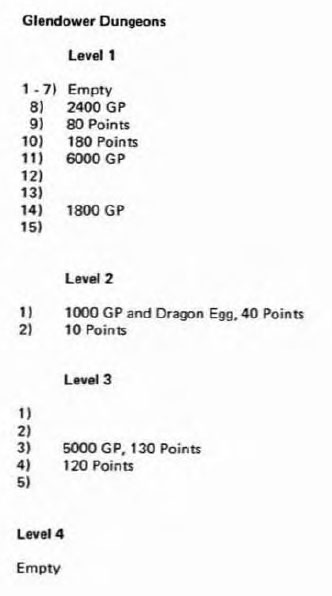
As I described in Reactions OD&D: The Arnesonian Dungeon, I found this particular format fascinating because the combination of treasure + protection point budget creates a specific tactical “shape” for the dungeon, but allows the GM to completely reinvent the dungeon on-the-fly each time they run it: This time you spend the protection point budget on goblins and ogres and the Glendower Dungeons are an outpost of the Goblin King. Next time you spend them on Nazgul and it’s a wraith-infested ruin haunted by the ancient nobles who once ruled its halls. The next time it’s infested with giant spiders. And so forth.
A Glendower template can also allow the GM to more precisely indicate what the inhabited areas of “interest” are in a dungeon while still providing an ample opportunity for random generation to create spontaneity in actual play. (That is not the case here; this Glendower template of the Blackmoor dungeons was randomly generated.)
SEED 1: This was the result of me fully stocking the Blackmoor dungeon levels. This is the version of the dungeon that I’ve been running (and which it looks like I’ll be continuing to run for awhile longer as an open table).
SEED 2: To demonstrate the flexibility of the system, I started over and started a second seed of the entire dungeon. (This took about 45 minutes to do all seven levels.) Perhaps the most notable take-away, in my opinion, is how the same stocking procedure can create radically different versions of the same dungeon.
For example, in the Seed 1 version of the dungeon I generated only one encounter (featuring 23 hobbits) on Level 1 and Level 2 was also sparsely inhabited. In Seed 2, however, the upper level is filled with hostile fey (including an attack force in the very first room!) and Level 2 is crawling with bad guys. In play, entering the Seed 1 version of the dungeon was a slow, tense build as empty corridors rolled out behind the party. The Seed 2 dungeon, on the other hand, would be an immediate meatgrinder.