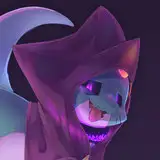
Pufferpus (Sepiavis pernix)
The jetsquids are one of the more recently evolved groups within the subterranean biosphere (by the sluggish evolutionary standards of this environment), and have have only split off into two different species in this time, the larger jetter and the smaller pufferpus, which together occupy niches equivalent to birds-of-prey on the surface, although differ in hunting methods and prey preferences. The pufferpus is a small animal, being only about the size of a common starling, but is a ferocious predator for its dimensions, commonly taking on prey larger than itself. It is every bit as dangerous to flying umoh species as the larger jetter, swooping down at high speeds and extreme precision, quickly dispatching its chordate quarries with a powerful bite to the neck. Its smaller size allower for far greater maneuverability in narrower spaces, allowing the pufferpus to pursue prey in much more confined crevices and understories, able to dive and swoop through openings less than ten centimetres across. Compared to the jetter, the pufferpus hunts smaller umoh species, as even these will make a substantial prey capable of sustaining them for more than a week.
Unlike chordate fliers, jetsquids are actually ectothermic, and utilize the chemical reactions which produce their "jets" to heat their blood and temporarily raise their metabolism for hunts, but otherwise allowing them to only require a small number of successful hunts to survive, unlike an endothermic predator which needs to make a successful kill every day or two. The pufferpus is, by technicality, often a forest-dwelling species, commonly nesting in the massive fungal jungles where life flourishes in greatest abundance in Diyu, as they can easily navigate the tangled vines of mycelium and decaying silken or mucous threads of animal activities. Smaller than jetters, they can move with surprisingly nimbleness by climbing with their hooked claws. Although they primarily hunt umoh species, a significant portion of diet also includes small terrestrial invertebrates such as pebblers, which it can swoop down and snatch up in mid-flight. Its powerful beak, designed to efficiently kill prey its own size in a single bite, is just as effective at crushing the carapaces of arthropods much smaller than it. Petal worms make up a small portion of their diet, but pufferpuses tend to find them distasteful and they are not a preferred food item.
The pufferpus is much more social than the jetter, living in loose colonies or family associations sometimes nearly thirty strong, usually consisting of several mated pairs (or sometimes throuples) collectively defending the area and one another against other threats. The related jetter sometimes attempts to predate on them, but this is rare due to the high effort required compared to umohs and due to their tendency to mob jetters at first sight. Although a fraction of its size, their far greater number and agility advantage can result in serious injury should they stray too close to a nesting colony, even human-sized threats will be mercilessly dive-bombed, as they attack with fly-by scratches of their hooked talons. Pufferpuses will first attempt to warn off threats by rapidly flashing their phosphorescent maws, which is also used for signalling to other members of the colony of danger, as it is easily recognized even a few hundred feet away thanks to their highly developed vision. Hunts are usually accomplished alone or within the immediate family unit, although hungry strangers have been known to "beg" returning individuals returning from a successful hunt for scraps.
The jetsquids construct nests out of hardened threads of mucus (somewhat similar to the nests of cave swallows), creating dome-like structures glued to large fungal bodies or stalactites, with a single opening, and then embedding granules, hairs, loose hyphae, soil, small shells, and other tiny objects to the outside surface in order to camouflage it. Raising of eggs and young is slow, as is expected, and it can take up to fourteen months for young to start hunting for themselves, and even longer for them to become completely independent. Pufferpuses are cooperative breeders, and parents are assisted by older young from earlier clutches and other members of the colony which do not have their offspring. The greatest mortality rates occur during the periods of fledging and independence, as the pufferpuses stumble in flight attempts and drop to the ground, where they are easy prey to ground-dwelling hunters unless they can quickly clamber up a tall structure.
---
This is a commission for the pufferpus, and is now the last Diyu entry to be created since the paddle-ant entry in April of 2018 (which I didn't even write) This animal was seen in the background of several other images, but never got an entry before Diyu stopped.
Glarn Boudin
2023-08-01 04:16:06 +0000 UTC