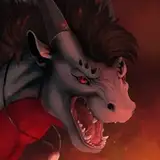
The only animal that needed to be changed, the Anurognathus, which has been changed to the tentatively classified anurognathid of the Morrison Formation, Mesadactylus, due to the fact Anurognathus is only known from Germany, not the Morrison Formation. However, Mesadactylus is known from very fragmentary remains which tell us very little about its actual appearance, so this is just modelled on Anurognathus, except slightly larger. It is still by far the smallest animal in the parade, with a wingspan of only seventy centimetres (I had to draw it at a larger scale and downsize it, and the larger version is included).
The redesign is possibly the most drastic of any animal in the chart, Ornitholestes included, not just for its thicker coat of pycnofibres, but for the revamping of the skull. I was always a little confused seeing all the newer Anurognathus restorations because they were so radically different from how it appeared in WWD. What happened in between? Well, it turns out WWD, and a lot of earlier Anurognathus restorations, made a rather big mistake; they put the eyeball in the wrong skull hole. This isn't entirely their fault, as the only Anurognathus skull material at the time was very poor and the numerous exquisitely preserved Asian anurognathids hadn't been discovered yet. The skull was restored incorrectly, resulting in the eye being placed much further back and smaller than it really was. It wasn't until a much better preserved Anurognathus was described in 2007 that the mistake was realized.
This leads into the aspect involving the speculative behaviour of being oxpecker-like symbionts, crawling about on the backs of sauropods. Leaving aside the issue that Anurognathus isn't known to have coexisted with large sauropods, the better preserved anurognathids make this specific lifestyle is unlikely. Why? Because its eyes were huge. Really huge. So huge that each individual eyeball was bigger than its brain and the orbit was half the length of the skull. From this, a likely lifestyle of a twilight or nocturnal aerial insect-hunter was surmised, a prehistoric nightjar, microbat, or swiftlet, capable of great agility and speed chasing and catching very small prey on the wing and capable of detecting the slightest movements in the dimmest light. That said, I think it's very plausible they may have followed the movements of large dinosaurs, because nothing attracts flies, biting midges, and and other insects like a herd of huge grazing beasts.