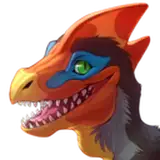
To reiterate, this was a commission sponsor for a sky island-dwelling gup.
A new biome which has appeared in the last few million years are the massive colonial spire trees, which fuse together to form artificial mountains that can tower over a mile high and stretch for hundreds of miles; these are some of the largest structures ever created by any living thing. These sky forests evolved in the north, where heavy selective pressure from the presence of the gargantuan browsing skuorcs led to the evolution of flora which could protect themselves from some of the most powerful and destructive eating machines Serina has ever seen, but it was not long before they reached the shores of Serinaustra, establishing a brand new frontier for life in the southern hemisphere to conquer.
Among the first to adapt to these towering montane jungles were, rather obviously, those which had already become accustomed to life in the canopy, those arboreal animals which had long since honed the natural tools with which to clamber nimbly high above the ground. The tree gups, those slender and swift snarks, clinging tightly to branches and leaves with sticky toe-like pads and able to leap from tree to tree with flattened fringes of flesh along their appendages that carry them through the air, took to the sky islands like a fish takes to water. Their attributes, which had made them such skilled climbers in the dancing tree forests, were refined further as they were literally elevated to live in a world above. Smaller and more lightweight, their gliding membranes became broader and wider, their bodies even slimmer and aerodynamic; while their tree gup ancestors could perhaps venture flights of a few hundred feet, the skygups are capable of glides of over three-hundred metres under good conditions.
Two pairs of pivotable wings and a stiff balancing tail allow the snarks to curve and swoop adeptly in flight, and it can seem to soar nearly as agilely as a bird or tribbat in flight, although, unlike them, it can only rely on lucky updrafts to grant it more height during its bouts of flight. Skygups are even skilled enough to snatch flying insects out of the air, not that it's particularly hard in the moist, tropical environment where insects of all kinds swarm day and night. One issue which the skygups faced due to their gliding membranes is loss of water through such wide, thin permeable surfaces; to prevent this, the gups secrete a waxy coating of mucus over their body which retains their moisture, although this needs to be sloughed off every few weeks, and these wings can be partly folded and retracted when not in flight, which also helps keep them out of harm's way when clambering about. Skygups are more active in twilight hours, avoiding the harsh sunlight of the midday which would dry them out more quickly. In the few hours of dawn and dusk, it is not uncommon to see hundreds, if not thousands, of skygups leaping from spire to spire after the dimly-lit outlines of flying insects swarming in the damp air. During the heat of day, they tend to hide in sheltered grooves and abandoned burrows within the spires, sometimes crowding together in groups of dozens; because their gliding allows them to easily travel great distances while expending little energy, groups of skygups can rest together without worrying so much about competing with one another when active foraging.
There are numerous different species of skygup; their basic shapes and habits are similar, they differ mostly in colouration and in the particular preferences of elevation level and prey types. The scarlet skygup is so named for its vibrantly red wings, an honest signal of its distasteful nature gained from a diet of toxic beetles. When apparently cornered by a threat, it secretes this foul oily fluid from glands along its mantle, which flow down its appendages and render it temporarily inedible (although some more intelligent predators know to "wash" the gups to get rid of the poison or strike quickly enough that it does not have time to release its toxins). When its wings are retracted the vibrant shades of its wings dull to camouflage it while at rest. Skygups mostly hunt insects and other small invertebrates, but, similar to many snarks, have diversified their diet from their purely carnivorous ancestors, and will also eat small fruits and pollen, and drink nectar, high-energy food stuffs which are much easier to catch than live prey.
During epiphyte flowering periods, their extra supplement to their diet gives skygups extra energy for courtship and mating. Since they are very small, usually under a foot, and sometimes only a few inches in length (the scarlet skygup averaging around six to seven inches in length), the males rapidly flick their brightly-coloured tails and appendages in bursts in the hopes the eye-catching movements will be noticed by a passing female. A helpful adaptation for this is their acute vision, exceptional among gastropods, which developed as excellent eyesight was vital for an animal which often spends time in the air. Young skygups are highly developed at birth, beginning life as tiny replicas of their parents, although they tend to be more clumsy in the air, and spend a lot of time during their first few weeks of life practicing glides on small gaps between branches in lower boughs before attempting true flights across the sky forest.
---
(This lives 290 MYH)
Grant
2023-03-22 19:51:42 +0000 UTCJack
2023-03-21 12:19:02 +0000 UTC