Siberian/Horned Droc (Monocerasaurus robustus)
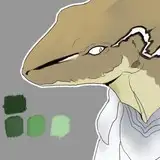
One of the largest of the drocs, reaching over three-hundred kilograms (660 lbs), the Siberian droc is one of northern Russia’s most feared carnivores. Pairs of the large carnivorous ornithischians stalk the cold taiga forests in search of prey; they hunt large animals, using coordinated tactics to bring down prey. One animal charges at the prey to lead it into a more confined space, while the other animal comes in from the side and rams the prey with its horned head. The large single horn on the animal’s head is built for goring, and for most prey animals a single hit is enough to cripple them, allowing the drocs to finish it off with their sabre-teeth. The long sabres are delicate and occasionally the droc breaks them biting into prey, however the teeth will grow back over time, and the droc is able to survive perfectly well without them. It may be that the teeth were originally more valuable as killing organs in an earlier ancestral form, but after modification of an intraspecific weapon into an interspecific weapon it became less essential.
The shaggy plumage of the Siberian droc is dense to keep in heat, and in this species, even the tail is heavily plumed. The species is monogamous, with pairs foraging, nesting, and rearing young together. Rearing of young occurs during the short summer, and to take advantage of this, they nest during the late winter so that the young will hatch just as the snow starts to thaw. This is of course a gamble, because if the winter lasts particularly long, it may be harder for the parents to find food for the hatchlings in their first few weeks. The drocs defend their young aggressively and are more than capable of seeing off large predators with their horns. They keep their horns sharp by rubbing them up against trees and rocks, which they also do to mark their territory.
---
Eastern Droc (Guialong orientalis)
Marked by its distinctive blue head and pink skin, the eastern droc is one of the more unusual dracocephalosaur species, possessing of large pronged horns which jut from the head. Reaching four metres in length and a hundred and fifty kilograms (330 lbs) in weight, the eastern droc is a moderately-sized carnivore, but hunts mostly small prey. It is one of the most water-inclined droc species, and is often found near ponds and rivers, hunting for cold-water fish, amphibians, and crustaceans. Although widely distributed throughout eastern China, Siberia, Korea, and Japan, it prefers the more forested upland terrain, where it hunts for the abundant aquatic prey coming down from the mountain streams, and larger predators are scarce. Its favoured prey are the large aquatic salamanders which are common in this habitat.
Its bright blue head and horns are mostly for show, but like all pachycephalosaurs, they are able to withstand physical combat, which is often inevitable; broken horns and teeth are common in older adults, but while teeth will grow back, horns do not. Eastern drocs are agile, but not particularly swift, and in most circumstances will face off against potential threats. A cornered droc will fight savagely until its last breath; on one occasion the aftermath of a battle between a pack of tsurube and an eastern droc was documented, the droc was felled but not before it killed four of the troodonts.
---
Saharan Horak (Afrodraco septentrionalis)
There are two species of dracocephalosaur known from Africa, both of which are in the genus Afrodraco, and of which one is exclusive to the continent. The Saharan horak ranges over much of northern Africa, from Morocco all the way down into parts of Ethiopia. It is well-adapted for a wide range of habitats that it encounters over its distribution and can be found in forested regions to the harsh sand dunes more north. The species is one of the smallest dracocephalosaur species, reaching only about forty kilograms (88 lbs) in weight on average. Inversely it has the longest sabre-teeth of any species, which are used to quickly dispatch small prey, although it may hunt animals up to two-thirds of its weight. Its huge front claws are used primarily to dig burrows in which live in and hide from the harsh midday sun but are also useful for ripping open termite mounds; termites make up a significant portion of the diet of some populations of horak. It is also used for defence; when threatened, the horak will retreat into its burrow with only its armoured front half exposed and attack any interlopers with its fangs and claws.
The horak is most active during the early morning and late evening when the sun is near the horizon, and when foraging usually does not venture more than a few hundred metres from its nearest burrow, of which it may have more than a dozen. Some of its dens serve no further purpose than to be decoys that make it more difficult for predators to find where the horak may be hiding during the day. These dens are also used for the horak’s nests and where it rears its chicks. A species of insectivorous enantiornithean known as the drakeye is known to live and nest in these burrows without fear from predation, as it keeps the burrows free of pests and warns the horak for predators when both are foraging. The horak is territorial and intraspecific combat is common, but the aldrak’s thick armour protects them from most potential injuries.
The Saharan horak’s closest relative is the western horak (Afrodraco occidentalis), native to East Africa and parts of Asia into India. This species is slightly larger and distinguished by its darker skin colour and more social behaviour. While the Saharan horak is aggressively solitary, the western horak is monogamous and mates for life, although the two animals usually forage separately. Although the western horak ranges into parts of Asia, genetic studies have suggested a European origin for the genus, probably having become isolated on the continent when the Mediterranean Sea refilled itself.