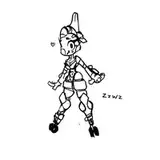
I posted the artwork here already, but a friend helped find the written documents that accompanied them, so I'll repost the artwork with the text that was written with it.
---
Among the numerous theropod and crocodyliform predators across the world is one group of dinosaurian carnivores that is unique for having emerged from ornithischian stock. Able to survive further north than the uruguayusuchids and abelisaurs, they have claimed dominion over much of Eurasia, having slowly moved up from generalist omnivores during the Eocene, they were more agile and nimble than the two-legged theropod carnivores, with wider hips allowing for easier maneuverability and the ability to seamlessly switch from bipedal motion to four-legged running. These were simply traits borrowed from their herbivorous pachycephalosaur ancestors, one branch of which became increasingly carnivorous during the Neogene. The earliest known remains of dracocephalosaurs are known from the Irdin Manha Formation of Inner Mongolia, although only as scattered teeth, vertebrae, and skull pieces, which suggested at a dog-sized animal; even these scant fragments were enough to show their thirst for blood had appeared by then.
Following the extinction of tyrannosaurs and abelisaurids in Eurasia at the end of the Eocene, new groups of predators evolved, among them the pachycephalosaurs. One of the earliest well-known dracocephalosaurs is the species †Secodontotherium eosmilus, a seventy-kilogram (154 lbs) animal known from parts of Europe of the Mid Oligocene. Its tusk-like sabre-teeth were more than twenty-centimetres in length, far larger in proportion to its size than that of any modern species, suggesting it was an offshoot that did not leave descendants. Most dracocephalosaurs remain within the fifty to two-kilogram size range until the onset of the ice ages during the Pliocene, when a dramatic increase in size occurred. The largest member of the dracocephalosaurs is believed to be the extinct †Gryphorex teratodon of the Early Pleistocene of Eurasia, with some estimates based on fragmentary remains suggesting at a nine-metre (30 ft) animal weighing over two and a half tonnes (5500 lbs). Its sabre-teeth were nearly fifty centimetres (20 in) in length, and it is believed to be that this monster was adapted to hunt the mega-ceratopsians that once roamed the steppes in great herds before the end of the ice age. No modern species reaches near these proportions, but it is just as well, as prey animals they encounter are not quite as often the proportions of those faced by Gryphorex.
Dracocephalosaurs are marked by their distinctive heads; their jaws are prominent heterodont tooth formation, with a sharp curved beak at the front, long sabres behind the beak, and shorter and more robust teeth behind those. The beak and sabres assist in gripping struggling prey, while the teeth in the back of the jaws are used to crush bone and rip apart meat. An important hunting asset of the dracocephalosaurs are the arms, as they will rip and slash into the prey until it is dead of blood loss or serves to restrain prey while they deliver a fatal bite with their sabre-teeth. The head is thickened and covered in bony spikes and knobs; like their herbivorous ancestors, they will ram and batter one another, and occasionally other animals as well. The length and robustness of the arms allows them to walk on all fours, some species are able to switch between postures, while in others, the combination of large skull and forelimbs forces them to adopt a largely quadruped stance. This return to quadrupedalism may have caused the reorientation of the neck vertebrae to the typical dinosaurian state from the derived pachycephalosaur one. Their coats of protofeathers allow them to survive harsh weather conditions, and many species have shown a pension for consuming some vegetation under certain circumstances, allowing them to be widespread wherever the falcognaths and uruguaysuchids do not dominate. Fragmentary remains suggest they may have even reached North America millions of years ago but became extinct on the continent for unknown reasons before the present day. All modern species are known from the Old World, where they have become a respectable member of the large predator guild, which had normally been dominated by theropods and pseudosuchians since the beginning of the Mesozoic.
---
Keython (Smilovenator tyrannorex)
Stalking the forests of eastern Europe is an immense predator like none other that exists; at over one tonne (2200 lbs) in weight and six metres (20 ft) in length, the keython is by far the largest dracocephalosaur on Earth. Particularly large specimens may approach seven metres (23 ft) and thirteen hundred kilograms (2900 lbs) in weight. Under its skin is a layer of small bony osteoderms which act as armour, making a healthy full-grown keython almost impervious to attack. Its sabre-teeth are relatively small, because there is little point in such weaponry when a regular bite is more than enough to dispatch most prey. The keython is a generalized predator that will eat basically anything; it has been known to dig burrowing animals out of their dens, fish in rivers, raid nests for eggs and hatchlings, and scavenge for carrion. Using its size, it can easily bully most predators away from their kills, eating those that don’t flee at first sight. The keython is capable of standing up against predators larger than it and has been known to hold its ground against even the [unnamed mega-dromaeosaurine], which may weigh almost twice as much. During the winter, the keython may consume plant matter to help it sustain it. Like all dracocephalosaurs, it does not hibernate and remains active year-round; during the winter, keython are particularly aggressive as they struggle to find enough food in the snow.
Although solitary, there are unreliable reports of pairs working together to hunt adult ceratopsians, incredibly dangerous prey even for the enormous aldrak. Most often they hunt young animals by chasing them into snowdrifts, where they become stuck and the keython can more easily move around them to their hindquarters to kill them. The keython nests during the spring and constructs huge nests that can be more than five metres across. The three to six eggs are hatched and raised by the mother alone, until around nine months of age, when they are forced out on their own. The highest rate of keython mortality occurs during their first winter on their own, although if they survive this period, they have a relatively good chance of making it to adulthood.
---
Mountain Aldrak (Carnocapra oreius)
High upon the montane slopes, theropod carnivores are scarce, as their obligate biped posture makes their movement inefficient on the steep uneven terrain. Mammalian or pterosaur carnivores usually dominate in such environments, although in some regions dracocephalosaurs are representative of dinosaurs, able to traverse the landscape well due to their ability to move quadrupedally. The Alps, for example, are dominated by a species known as the mountain aldrak, a two-hundred-kilogram (440 lbs) predator that is only outweighed in its native range by the largest azhdarchid pterosaurs. Its dense mottled pelt allows it to stay warm in the bitter chill of the high mountains, and camouflages well on the snow-covered rocks. It mainly hunts the agile stenopternans and mountain-dwelling thescelosaurs that scramble over the range. Because its prey is sparsely distributed and often nomadic, the species is territorial and rarely sighted, as it travels far and wide in search of prey. The typical killing method of the aldrak is to pin the prey with its forelimbs and then sink its sabre-teeth into the throat, although for larger prey that it may have trouble restraining, it will ram them off-balance to stun or injure them and slashing them with its claws to weaken it through blood loss. Common prey are the agile mountain stenopternans and thescelosaurs around the range of forty to a hundred-kilograms, although small birds and mammals are taken opportunistically, and on one occasion an aldrak was documented dragging the carcass of a subadult ziz back to its lair.
Four other species of Carnocapra are known from throughout Europe and parts of western Asia, the largest being four-hundred kilograms, and the smallest reaching just over fifty kilograms. In each species the orientation, size, and position of the head ornamentation is different, which is useful in distinguishing the aldrak species from one another.
---
Sicilian/Dwarf Aldrak (Carnocapra pusillus)
Several million years ago, the Mediterranean Sea dried up, and a few million years after that, the basin flooded again, stranding many inhabitants on mountains that became islands in the sea. Millions of years of isolation prompted the evolution of species unique to these islands. On the islands of Sicily and Malta, one species of dracocephalosaur is the largest native land predator, although it only weighs on average of fifty-five kilograms (120 lbs), only a quarter the weight of its mainland relatives. Despite its size, it is robustly built and more than capable of tackling prey up to its own size. The species is one of the most social of aldrak species, sometimes forming temporary mobs of up to seven to hunt the larger hadrosaurs it coexists with, which may weigh over two-hundred kilograms. However, the coordination of these packs is crude at best, and once the prey is killed, the aldraks will quickly on each other to get the best portions. The occasional azhdarchid that visits the island are the only predators that the dwarf aldrak has to worry about itself.