Welcome to new Patrons K L and Denise! 🎉🎉🎉
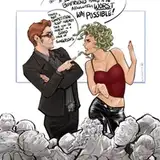
New lineart for a piece called "Answers". (Spoilers for C3_51!)
For six years, Orym has been asking the same questions about the attack that saw his husband and father in law killed: Why Zephrah? Why Derrig, why Will? Why did they target Keyleth?
Now he has all the answers he never wanted. It was never about his husband and father. It wasn't even about Keyleth. Keyleth was just bait; Will and Derrig were just in the way. It was all to get Vax, a guy he only knows from hearsay.
Poor little guy. I wonder how he'll deal with that.
(Fun fact: the image above holds three of Liam's characters, I didn't even realise while drawing!)
Now I've been thinking a lot about inking lately, and watched a few clips and tutorials in which I was always missing some of the advice or realisations that have helped my own inking skills most, so if you're interested, here goes!

⬆️ 1. Make your sketch as strong as you can. All problems in the sketch will double in the lineart. So if you hate hands and feet, don't tell yourself you'll fix them in the final lineart. Chances are you won't.

⬆️ 2. Don't make your sketch too dark. The absolute worst is having a great pencil sketch (drawn in soft pencil), inking it thinking it looks great, then erasing the pencil… and staring at an abomination! The easiest way to avoid this is to ensure you can tell your inks from your pencils without half trying while you work. Pencil lightly, half-erase the sketch, or if working digitally, make it so light that you can hardly see it. That way, what you ink is what you get.

⬆️ 3. Line weight. Always make sure to vary the thickness of your line from important to unimportant elements (and/or between foreground/background, or between any number of style-influenced elements). This is a good tip on its own, but combine it with the one above for maximum effect, or you might mistake your bold pencil sketch for a bold ink line where there isn't one!
4. Switch back and forth when working digitally. If you're unhappy with the lineart but the sketch was solid, turn off your lineart layer and work out where you took a wrong turn. This helps me tremendously to fix skewed lines that happened without me noticing. And accept your sketch will in all likelihood still have bits in it that look better than in the lineart. This *is* something that you can , and will, indeed fix with colour when dark elements can go back to being dark.
5. Kill your darlings. If you find yourself fix-worsening your lineart for more than ten minutes, erase that element and start over. It'll always look better and go much faster than fiddling with something that you've been making worse for some time.
Jenny Dolfen
2023-03-21 14:08:02 +0000 UTCDeniz Bevan
2023-03-20 08:15:14 +0000 UTCJenny Dolfen
2023-03-19 10:00:58 +0000 UTCRobin Wyatt
2023-03-19 09:58:24 +0000 UTC