Download the full uncensored inking video
Transcription
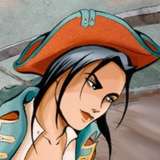
Hello watchers! Back again with another video, this time to provide commentary on the inking process of last month's illustration featuring Anne Bonny as the guest star. The inking process took a little over an hour, so I'll highlight the best parts, trim others, and speed up the video as needed to keep it around ten minutes. Wish me luck!

The brush is my most valuable tool. While some artists prefer nibs or markers, I'm an artist of the brush. Although I do use other tools, the majority of my work is done with a brush. Specifically, I use a brush made of red sable hair because it is highly resilient and, when wet, maintains a very sharp point. The brand I prefer is Da Vinci Maestro Kolinsky series 10, with a brush size of 3.
The ink must be Indian or Chinese black ink because is water-and-light-resistant.
I start with short lines to warm up my hand and pulse. I can create very short lines with my sharp brush, although there may be other tools more appropriate for this. But as I've mentioned, I prefer using the brush. It's a matter of love, you know.
I take special care with the curvy lines, especially on the most sensual parts of the body. So I breathe and trace, without fear.
And now it's time for the long lines. I try not to separate the point of the brush from the paper, but it depends on the day. Am I concentrated enough? Well, sometimes I need to go over the inked line and make corrections. Making a mistake isn't the end of the world; I can take advantage of it. Inking isn't a mechanical stage; on the contrary, I use creativity to transform not-so-good lines into better ones. And when all else fails, I can use white watercolor to correct imperfections. One thing is certain: if I were to ink two identical pencil drawings, they wouldn't look the same in the end. That's the magic of traditional inking.
There are thin and thick lines. I apply more ink to mark the inner angles. Similarly, I add extra ink to create shadows, like those cast by the clothes on the body, such as the cuff on the hand. This technique adds volume to the drawing.
Legs require especially long lines. I gather my courage... Breathe... and trace... Done!
More curvy lines demand special attention from me.

Sometimes, I opt for perfect lines using a curved or straight ruler, but exclusively for backgrounds or objects like knives or swords. I also use rulers and markers for motion lines. Personally, I don’t favor the impersonal trace of a marker, but I'll use it if it enhances the effect.
Lately, I've been using a G-Pen nib, favored by manga artists. While I've experimented with various brands and types of nibs, the G-Pen is the one that instills the most confidence in me. It's flexible and reliable, especially for short lines.
And finally, the signature. It's ready for scanning and coloring. Good job!
Reina Canalla
2024-03-28 18:34:26 +0000 UTCDante Remy
2024-03-28 15:01:44 +0000 UTCReina Canalla
2024-03-25 18:59:25 +0000 UTCZungur
2024-03-25 14:38:17 +0000 UTCZungur
2024-03-25 14:36:56 +0000 UTC