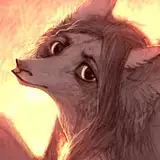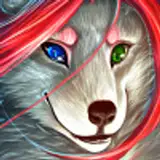
The Urukanušura, “Great Running Falcon,” or simply Uršura, “Great Falcon,” once roamed the now-sunken lowlands of Tenehu. After the cursing and flooding of the land, some made it to higher ground, where they now hunt along the narrow fjords.
They have adapted well to this new environment, hiding in the woodlands at the valley floors, only to burst forth at unsuspecting prey. They drive their quarry along the narrow strips of land, where escape is made nearly impossible: dense forest and mountains on one side, water on the other, and the Uršura—swift and relentless—close behind.
Though they usually hunt alone, Uršura are sometimes seen in pairs or even family groups. When they coordinate, they can drive prey into ambushes, leaving no path to safety.
Uršura will eat anything from mountain goats to Eukkir, to men. Villagers often leave carcasses at the edge of their settlements to keep the birds sated and away, though this sometimes backfires by attracting more of them. Few dare to strike at such predators, not only because of their ferocity, but also because the Uršura are seen as living reflections of elven rule—swift, merciless, elegant, and utterly dominant.
Some elves even dress in garments made of their feather’s to further instil awe in their beholders.
Instead, villagers rely on charms and prayers to ward them off, though to little avail. Tales are told of the Uršura as wild hunters belonging to the Cursing King himself. Parents warn their children not to stray too near the woods, lest “the Great Falcon find you.”
They nest on cliff ledges or among the many broken ruins that scatter the cursed realm. Their nests are perilous places, filled with bones and bronze fragments, and few dare approach them. Yet some do, for a Uršura egg is a prize of great value.
The intelligence, speed, and terrible beak of these giant birds make them feared predators. One never knows if an Uršura waits unseen, ready to pounce the moment vigilance falters. Because of these qualities, elves have long used them as hunting beasts, much like ordinary falcons. Brought along on patrols, they are unhooded when prey is sighted. The handler pulls the cord tied to the hood, releasing the bird, which immediately sprints toward its target. Care must be taken to aim them correctly: a retainer holding a long stick with a piece of fresh meat at the end helps direct the beast, for the smell of blood sharpens its predatory focus.
A charge by an Uršura can scatter troops in terror, breaking formations and forcing an opening for the soldiers follobehind. But it is crucial to follow the bird closely. Once it has felled its first victim, it may be surrounded. At this moment, the retainer must use his stick to slip a cord over its head, wrestle it under control, and reattach the hood. Only the bravest and most highly trained individuals can perform this task. Such handlers are greatly sought by elven lords, who prize these birds not only as symbols of pride, but also as sources of joy—for few things please the elves more than a good hunt.
Entire hunts are sometimes staged as religious ceremonies, with the Uršura representing the wrath of the Cursing King, tearing prey apart as a sacred offering.
⸻
Children’s Rhyme
Stay near the fire, child, stay near the fire,
For the Great Falcon waits in the wood.
Eyes like amber, claws like daggers,
It runs where no man ever should.
Stay by the flock, child, stay by the flock,
The Great Falcon hunts in the fog.
It leaps from the shadow, it strikes from the stone,
And drags away lamb, goat, or dog.
Stay in the light, child, stay in the light,
The Great Falcon hungers at night.
The elves unchain it, the Cursing King guides it,
Beware of its scream in the night.
Joe Kane
2025-09-19 18:25:41 +0000 UTCDidrik Magnus-Andresen
2025-09-19 15:59:17 +0000 UTCSydney J Freedberg
2025-09-19 13:44:32 +0000 UTC