The sun burned on their hunched backs.
Not used to such warmth, many of the warriors had removed the top part of their fur suits, tying them around their waists. The copper bells hanging from their belts had been stuffed with moss—now they needed stealth more than the bells’ warding powers.
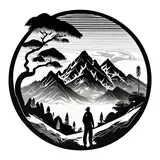
Though numbering no more than a hand, they were all warriors. Like the rest of their kin, the Orhaindar, they were used to hardship. But as they lay surveilling the fortified farmstead below, each of them silently gave thanks whenever a gust of cool, familiar mountain breeze passed over their backs. Their only worry was that it might carry their scent down to those they watched.
“We should have waited until nightfall,” one of the warriors muttered. Some nodded in agreement.
But the one with the embroidered veil over his face simply looked at him sideways. His body was lean and sinewy, and even at a glance, one could see he was older than the others. Yet his body still held great strength, and more importantly—judging by the many scars—it showed immense resilience.
“Look. What do you see?” was all he replied.
The younger warrior was caught off guard by the question.
“A field of flowing gold,” he said quietly, almost reverently. He had never laid eyes on such a sight before. It was as if the warm sun had lain itself to rest upon the ground, the golden grass swaying gently in the breeze, glittering as if waves passed through it. He had never seen anything so rich, so blessed. Where he came from, not even trees could grow—only meagre patches of shrubs and grass among bare rock for the cattle to graze.
The older warrior smiled behind his veil at the younger’s awe.
“Yes. And it is for this bounty we have come. But I was not speaking of the golden fields. Look again—at the farm itself. See how they’ve built their house atop a tall mound of rocks, surrounded by a wall of logs. The gate is fortified, and the door is thick. Even the roof is covered with turf where grass grows. There is no easy way in once it’s shut for the night.”
The warriors fell silent. Then the same one spoke again. “At night we could steal their golden grass and be gone, unseen.”
“Ah, the wisdom of youth,” the veiled warrior said with a hidden grin.
“But do you know how to harvest this grass? What tools do we use? How do we process it? Shall we eat it bare, like our cattle do?”
He disliked having to use such a tone, but there was no time to argue. Soon a dog would catch their scent, and a warning would be raised. Taking the farmers by surprise was their only real hope.
“Still your tongues and ready your arms,” he said. “Let us be swift, like the mountain fox, and pounce upon their nest.”
With that, the warband moved forward, almost crouching like animals on all fours as they crossed the stretch of open land before entering the golden field. Sweating as they passed through the tall crops, the young warrior couldn’t help but marvel at the riches. The closer they got, the clearer they saw how tall the palisade truly was. Its only entrance—a sturdy gate of thick logs—was half-open, wide enough for a man to pass, but not all at once.
Above the gate, three deer skulls with great antlers were fastened, a grim warning to any who sought entry without leave. The veiled warrior knew the warning to be true—he had been here before. Three times, or perhaps four. Always for the same reason: the bounty of these radiant fields. But those times they had come at the end of summer, after the harvest, and in greater numbers. Now, they were desperate.
Since the comet appeared in the sky, woe had followed. It was the herald of a dreaded new epoch.
This past winter had been especially cruel. Snow still lingered just a short ascent behind them. Many of their cattle had died, and none of the offspring had survived. Even their own ranks had thinned, as neighboring tribes—driven by desperation—turned from allies to enemies. Some of his warriors had even deserted, joining a rebel named Aurenek, who proclaimed the leadership of the tribes had grown stale. Aurenek promised to break the old taboos, reclaim the abandoned fortress, and lead the people to reconquer their lands.
Barking rang out. The old man cursed himself for letting his mind wander at such a moment. It was too late. Alarms were raised. Commanding shouts rang from behind the wooden walls.
He knew lying down in the grass would not save them now. Instead, he beckoned his men forward.
He rushed toward the closing gate, hoping to wedge his body between the logs—but he was too late. He slammed into the heavy timbers and bounced back. The rest of his warriors charged, but the gate had already been locked. They clambered atop one another, attempting to scale the wall, but shouts rang out above, followed by the release of an arrow. It struck the fur hat of the topmost warrior, grazing his temple but doing no lasting harm. Still, blood had been drawn—and the old warrior knew there was no turning back. His men would not allow retreat, not now.
They had to withdraw beyond bow range and reassess.
This was what it meant to be a leader: to adapt, to make swift decisions. Yet none of his choices thus far had succeeded. He knew it. His men knew it. And their eyes burned on his back—almost as hot as the sun above.
A shout came from the palisade, followed by another arrow that landed just short of them.
“What are they saying?” one of the warriors asked, panting.
“Suluké naru i talrunu mashta,” the elder replied.
“In our tongue: ‘Go back to the trolls who birthed you.’”
A snort came from one of the warriors. “If only they knew! Why do they think we’re here?” he quipped, to the sound of bitter laughter from the rest.
The old warrior smiled behind his veil. Their morale was not yet broken. But he knew it all hinged on what happened next.
He stood, baring his chest toward the palisade, and began shouting in a language unintelligible to his men.
Back and forth the shouting went. Eventually, he turned.
“This breed of slaves talks boldly from behind their walls. They know we cannot storm them.”
His men said nothing—they knew it was true.
“They say they have no surplus to give, except arrows to fill our bellies.”
They stared at him, silent and seething.
“I told them we would return after the harvest to claim our share. They laughed. Said they would take their chances, for by then we would be even fewer in number.”
His warriors trembled with rage, indignation burning in their eyes.
He knew they were not used to feeling powerless. He had to show strength—now—or lose them. Again he shouted foreign words. Frantic cries answered.
“I told them,” he said, turning back to his men, “that if they will not give us what is in their stores, I will set fire to their golden fields.”
His warriors looked at him in shock.
“They said I wouldn’t dare—for then we could never return to claim the excess of their harvest. For there would be none left to sow or reap.”
From behind the walls came what sounded like wailing.
The veiled warrior tilted his head slightly. “Now they plead. Their sharp tongues turned to clay. Their words mean no more to me than dirt.”
He saw awe and pride flicker in the eyes of his warriors—a fire rekindled.
He turned his back to them and sat down cross-legged among the broken stalks. From his fur suit he drew a piece of bone, each end stuffed with leather. Removing the plugs, he blew gently into it. Inside, a dried fungus—boiled, dried, and kept smoldering—glowed back to life. As he whispered half-forgotten mantras to ancient gods of fire and hunger, flames sparked and caught.
Quickly they spread, carried by the breeze.
When he turned again, his men were staring at him—half in fear, half in awe.
“Let us look elsewhere for food. For here, we need never return.”
With that, he walked away without a backward glance at the growing blaze, which consumed not just the golden field, but any hope of survival for those behind the walls.
His warriors shared a glance, then silently followed.
You reap what you sow, he thought.
And today, he had sown fire in the hearts of his men, showing that he would rather burn it all to ash than show weakness.
For as the swift fox pounces on the mouse, so too does man pounce on man.
And the weak are always prey.
Mind's Eye
2025-08-07 23:05:20 +0000 UTCChristopher Moody
2025-08-07 17:09:16 +0000 UTC