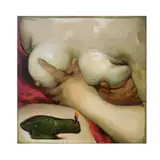
Kenneth Clark, in his book The Romantic Rebellion, discusses Jean-François Millet’s early focus on erotic nudes and his subsequent shift to moral subject matter. Clark notes that during the first decade of his career, Millet produced “skillful pastiches of Correggio and Fragonard,” creating works that were far from mere academic exercises. These early paintings and drawings of the nude reflected Millet’s intense sensuality, aligning him with artists like Poussin and St. Augustine.
A pivotal moment in Millet’s transformation occurred in 1849 when he overheard a passerby refer to him as “a specialist in bosoms and bottoms.” Disturbed by this characterization, Millet resolved to abandon such subjects, telling his wife, “If you consent, I will never again paint a picture of that kind.” Although he didn’t entirely succeed—evident in his 1850 painting Two Bathers—this decision marked a significant turning point in his artistic direction.
Clark observes that this renunciation was almost unparalleled in art history and carried inherent risks. By suppressing a substantial part of his persona, Millet risked impoverishing his creative faculties. Clark suggests that some of Millet’s mature works exhibit a certain drabness, possibly resulting from the suppression of his earlier sensual impulses. However, this transformation also led to the creation of noble and solid depictions of peasant life, which might not have been achievable without his foundational physical passion for substance.
In summary, Clark portrays Millet’s shift from erotic nudes to moral subject matter as a profound personal and artistic evolution, driven by a desire to align his work with deeper humanistic values
Noah Trapolino
2025-04-30 15:58:20 +0000 UTC