On erotic pain as a high and a history book
Added 2021-07-22 21:10:58 +0000 UTCI am a masochist. I am also a person with a history of chronic pain. I tried to find the connection between these two things, and also wrote about pain highs, the body which (naturally) keeps the score, and the tremendous power which comes from being on a receiving end of consensual pain.

I remember my first pain high very well. After a flogging scene, I lie on my back. I close my eyes and doze off for what could be a couple of minutes, or 30 seconds – time bends and stretches, and I’ve fallen through the cracks of it. When I wake up, I feel euphoric waves rolling through my body. It’s slow, like something dark and sweet and liquid, it rises and falls, like the tide. I can feel how blood reaches every part of my body, my limbs, my lungs, the surface of my skin. I then remember a bag of chocolate pretzels in my drawer. The thought fills me with excitement. I feel so safe and secure. Somehow, I wake up again, to the fact that a rope hip harness is digging into the side of my waist. The marks are red and deep. The pretzels are salty and coated in dark chocolate. I enjoy them melting in my mouth, as much as my body enjoys getting the energy, adjusting to navigating the world again.
As someone new to BDSM, in the beginning, I was convinced I wasn’t into pain – pain was just a tool enabling the thrills of dominance and submission. I quickly realised that as someone who was not into pain, I paid a lot of close attention to it. I knew that I preferred elastic impact tools to hard ones – because of how widely sensation varied, because of the stingy echo which reverberated through my skin a moment after. I loved it when people dug their fingers into my arms or thighs, so hard that it sometimes left me with bruises. I once traveled for an hour on the overground train to see a friend who had a go at my ass with a paddle that looked like a small cheese board (or maybe was a small cheese board). On the way back, the city gleamed in the dark. But it was that pain high that got me thinking that I might be a masochist.
We all know that pain is something to be avoided. In our rational minds, pain is linked to acute distress and culturally often described as an opposition to pleasure. This binary, however, doesn’t reflect our physical and mental complexity. Not only pain can feel good – we’re biologically programmed for pain and pleasure to be closely intertwined. “All pain causes the central nervous system to release endorphins – proteins which act to block pain and work in a similar way to opiates such as morphine to induce feelings of euphoria,” Zaria Gorvett explained a BBC article titled Why pain feels good. She pointed out that pain also causes the release of anandamide, which evokes a warm fuzzy feeling apparently similar to a weed high, and adrenaline which raises heart rate and excitement. The article explored pain through a range of activities including BDSM, running, and eating very hot chilies. Undoubtedly, all three of these could be enjoyed in equally intense measure, but putting pain in the erotic context – infused with intimacy and vulnerability hot chilies lack – involves experiences we’re not so used to talking about openly, or might not even have language for.
To me personally, being fucked on a pain high is one of the best things in life. So deep, so overwhelming, but also, it’s more than just fucking – somehow it’s like your cunt is a rabbit hole and you’re both falling into it. Pain for me is almost always linked to the sensation of expansive space. That moment when I don’t move or flinch anymore, when I actually enjoy pain, dissolve into it – I inhabit pain like it’s a room, like it’s a cathedral, and I look up, admiring its elaborate airy ceiling, its long shadows, and deep acoustics. I am always happy in it too. I feel whole.
Being a masochist is about enjoying pain – but no one ever tells you about the disorientating intensity of the actual high, about cumming from pain, or the emotional roller coaster which comes with it. Erotic pain is rarely written about extensively, because it’s at the intersection of a few things which are incredibly stigmatised in our society – sex, kink, and, well, pain itself. Pain is one of the core experiences of our human existence – and yet we’re mostly expected to hide it.
My relationship with pain has been intimate way before sex. Since childhood and up until 25 I have lived with chronic pain in my abdomen. It would come and go at various intervals, ranging from timid to overwhelming, a couple of times it landed me in hospitals in various countries, and I never had it diagnosed. It stopped after I had a surgery in my mid-20s, but the memory of it is embedded in my nervous system – in how I breathe, how I react to stress, how I regard my soft body with an equal measure of love and suspicion.
For all of us, pain is part of our memory, closely connected to learning how to exist and not die: touching a hot stove, falling off a bike. These lessons usually take place at the very onset of our personality. Pain, in that sense, is a history book. Pain taps into everything we carry in our bodies, sometimes without knowing – culture and ancestry, place and time, gender, childhood, and a lifetime of experiences. It’s all coded and stored in our bones and skin and blood and nerve endings. Choosing to experience pain can be a possibility to look into, and sometimes rewrite these codes.
While researching the connection between chronic pain and BDSM, I came across a paper by Emma Sheppard at City, University of London which explores exactly that – Chronic Pain as Fluid, BDSM as Control. The paper seeks to reframe the normative discourses of pain and presents some findings from a research project exploring the experience of people living with chronic pain who engage in BDSM play. It is very much an eye-opening read on stigma around pain, and especially chronic pain as a disability in our society. “My participants are not the first to have pointed out that it is not that people have a problem speaking about pain, but that people have a problem hearing about another person's pain,” Sheppard writes emphasising that talking about chronic pain is frequently connected with being othered. Sheppard also uses the term "bodymind" (as opposed to body and mind) to counter the duality and separation of these two things, which are, in fact, parts of a complex inseparable whole.
It might seem odd to think that people who have to live with chronic pain, would somehow want more pain – but the paper is full of incredibly interesting insights into why that could be the case. “Using pain within their play, participants were able to engage emotionally with their pain, and with their bodily selves, in a controlled space, and in ways in which they were in control, rather than relying on the judgement of medics or caregivers,” Sheppard writes.
In BDSM play, controlled and consensual pain can be a source of tremendous power – and very deep exploration of self. I credit my past chronic pains for my high tolerance – maybe mental more than physical. I also credit it for the long journey it took me to learn how to relax into pain. My initial reaction has always been of extreme tension, which helps me to keep pain under the surface. My initial instinct has always been to try and tough it out a bit more, to hold that safe word and handle a few more slaps – to that moment of questioning why would I put myself through this, to begin with. Past that moment, I found a liberating space where I could fall apart and still be desired, where pain, stress, grief could just flow freely through me without shame. The thrill of being vulnerable yet strong, the inexperienced level of intimacy with one’s body, the possibility of the unthinkable – pain as a safe space.
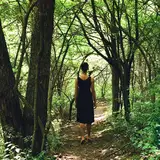
Photo by Anya Gorkova