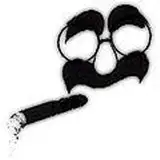
(Okay, before anything else, I REALLY should have just drawn the '70s hair over an actual photo of Lovecraft instead of trying to do a caricature. That 'stache and fro do a bit TOO much to make my doodle version of ol Howard unrecognizable)
As I’ve mentioned elsewhere, American International Pictures had a really weird relationship with H.P. Lovecraft in the 60s. You've heard this story SEVERAL times by now: Roger Corman had hoped to shake up the Gothic Horror/Vincent Price/Edgar Allan Poe formula back in ’63 by swapping Poe out for his biggest fanboy and adapting “The Case of Charles Dexter Ward.” But then AIP decided that deviated too far from the winning formula and and crudely slapped The Haunted Palace over the title so they could retain that Poe branding. And two years after that (and two blogs ago), AIP found themselves distributing an adaptation of “The Color Out Of Space” in the form of Die, Monster, Die! …a movie that ironically tried even harder to look like a Corman/Poe movie than Corman’s own Lovecraft movie that pretended to be a Poe movie. Finally, in 1970, AIP decided it was time to stop being half-hearted about it and dive head-first into a full-on Lovecraft adaptation, with the title intact and everything. With their attempts to revive the Poe Cycle sans Corman seeing diminishing returns, AIP seemed to hope that The Dunwich Horror would kickstart a whole new author-led movie cycle for a whole new decade; a clean break from the Corman formula. So I find it both funny and weird that Roger Corman still has a producer credit on The Dunwich Horror anyway.
Apparently, this brave new direction was actually a lot older than AIP was letting on, with Corman having begun work on the project all the way back in 1963. Presumably, Dunwich was in the running to be the follow-up to "Charles Dexter Ward" before Nicholson & Arkoff forced at return to Poe country. Or maybe not, what little information I could scrounge up before writing this is maddeningly inconclusive. As of my writing, I can’t tell if Corman ever intended to direct the project himself, or if the plan from the start had been for somebody else to run things on set for him. Even before leaving AIP to start New World Pictures, Corman still had plenty of side hustles that he’d draft other filmmakers to make on his behalf, and it DOES seem like Dunwich was at one point slated to be produced by Corman's previous independent outfit The Filmgroup rather than AIP. Plus, actual director Daniel Haller had not only worked on several of the Poe films, but he was the very man who helmed Die, Monster, Die! For all I know, talking with Corman about doing a Lovecraft movie might have been where Die, Monster, Die! came from in the first place.
But for all these strained attempts I’m making to draw connections between The Dunwich Horror and Corman’s Poe movies, it must be understood that they weren’t kidding around about this being a clean break from that cycle, and that means a lot more than shaping out one author who liked big words for another. Namely, The Dunwich Horror makes a big show about itself NOT being Gothic Horror. No, all those period costumes and castle sets are just old fashioned, MAN. This is the hip, happening, totally turned on and with it AIP! Everything about The Dunwich Horror had to be as trendy and contemporary as possible! …which of course means this end result looks like WAY more of a dated period piece than any of those films deliberately set "in the past". This movie looks like the word Nineteen-Seventy. Right from the first moment Dean Stockwell appears on screen with a full creeper ‘stache and white-boy fro and corduroy suit and mood rings on both pinkies, it’s clear we’ve got a beautifully preserved slice of that transitional period between dirty hippy hedonism and slick disco sleaze. Every frame of this movie looks like it wants to touch me inappropriately, and that’s kind of perfect for what it is. Remember, too, that Roger Corman’s interpretation of “Gothic Horror” was always significantly more garish and colorful than the term would initially suggest. Remember, when Corman first did House of Usher, the very fact that an AIP movie was in color at all basically counted as a special effect, and was shown off accordingly. More than a few critics have noted that Corman’s use of exaggerated, surreal color in the Poe movies bordered on psychedelic, so when Haller goes full trippy in Dunwich, to the point of using distorted lenses and posterized color effects in certain scenes, it honestly feels like a natural progression of the previously established style. Plus, for a movie set in “modern day,” The Dunwich Horror makes such heavy use of dusty old houses and occult shrines that the end result honestly looks no less “Gothic” than Die, Monster, Die! did before it.
And I’m just gonna say it, I’m a total sucker for this kitschy late ’60s-mid ‘70s aesthetic. I mean, just LOOK at my hair. Of COURSE I’m a pushover for suits with tacky neckties and lurid colors and the general ambiance of a custom van where bad things happen. In fact, between the gothidelic production design and Les Baxter’s pseudo-Prog soundtrack (not to mention the heavy use of ADR), The Dunwich Horror reminds me a lot more of 70s Euro-horror than the Corman Poe movies. Granted, it’s nowhere near as over-the-top as your Jess Francos or your Lucio Fulcis, but the stylistic similarities are pretty heavy nonetheless. And seeing as how that whole school of European Horror were so heavily influenced by those very Corman movies, there’s something quite fitting that AIP’s own attempts to continue on from them would end up moving in a similar stylistic direction.
Such a shame, then, that The Dunwich Horror is such a thoroughly “meh” film. Quite frankly, it could really have used a dose of Franco or Fulci to make proceedings weird enough for the weaknesses in plot and acting to not matter. Instead, the movie tries to play itself straight enough that the long stretches of stuff not happening or acting being thoroughly unconvincing have a chance to be a real problem. For one thing, hardcore Lovecraft fans will probably dislike the way the movie Dunwich simplifies the original story and sands off a lot of the cosmic edges of the Cosmic Horror. Admittedly, that’s a common complaint for Lovecraft adaptations, but the fact remains that this version of Wilbur Whateley’s dealings with The Necronomicon wind up being virtually indistinguishable from any standard grindhouse flick about Satanist cults. The plot still works, functionally speaking, but it’s also exactly the point where the movie needed to be LESS conventional, not MORE so. And speaking of Wilbur, I’m afraid another major weakness of The Dunwich Horror is Dean Stockwell’s leading role. Don’t get me wrong, the guy was a treasure, but he barely seems to be trying here. The movie clearly wants Wilbur to come across as a smooth, seductive charmer (which itself is quite the departure from the source material), but for the most part Stockwell just seems to be sleepwalking through this thing, with the bulk of his acting consisting of a derpy smirk or bug-eyed spaciness. Between his stiff weirdness and the goofy 70s hair, he honestly reminds of a white version of Dean Lerner from Garth Marenghi’s Darkplace, except that Richard Ayoade would absolutely have given a more compelling performance than Stockwell does here. Sandra Dee’s moderately more convincing as leading lady Nancy, though she ultimately has little to do other than be the distressed damsel. Ed Begley tries his best as Dr. Armitage, but I guess I’ve seen too many of this type of movie not to imagine Christopher Lee or Peter Cushing in this role, and that’s not a comparison that does Begley any favors. Either way, there’s just not enough going on in this movie, and what does go on doesn’t hit anywhere near hard enough. I mean, this is a movie about psychedelic Necronomicons and hippie Old Ones and a literal real life tentacle monster; a trashy drive-in 70s movie version of this stuff has no right to be BORING.
So, yeah, I can’t in good conscience give this movie a recommendation to general audiences. However, I also can’t in BAD conscience deny that I still enjoy it. Nowhere near as much as the Corman movies that preceded it, of course, but it still tickles my specific fancies enough to be enjoyable despite itself. If you also have a taste for the trashier, trippier strains of ‘70s Horror, but don’t mind a conspicuous lack of the surreal anti-logic that make those movies the acid trips they are, then The Dunwich Horror isn’t a complete waste. And if you’re absolutely desperate for SOME kind of continuation of AIP’s Poe Cycle, Dunwich does feel more like an expansions on those themes than either of the Vincent Price movies they tried to graft on at the end. At least, the first half does. The later half, where it starts trying to split the difference between a devil cult movie and a monster rampage flick pretty much loses those influences, and devolves into just a bunch of shots of hicks with riffles running around the wilderness at night. But hey, if you really wanted to see the unholy lovechild of The Devil’s Rain and Track of the Moonbeast… then this isn’t it, because what I just said sounds a heck of a lot more fun than The Dunwich Horror ends up being. Still, if that sentence even meant anything to you at all, then you’re the type of trash movie connoisseur who’d at least find a little bit of interest out of this one.
However, if you REALLY want to close the book on that Vincent Price era of AIP Gothic Horror, then there’s really only one movie that truly fits the bill…