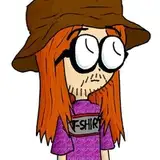
Okay, I don’t normally do this sort of thing, but I’m gonna start this particular blog off with a warning. Not a content warning or anything like that, or at least, not in the usual Parental Advisory sticker sense. If anything, I’m starting this off with something even more out of character: a trigger warning. Again, it’s not for anything lyrical, I didn’t put together a twenty-song tribute to self harm or something like that. It’s just… Chelsea-Lambda’s soundtrack sounds SAD. Like, physical depression inducing sad. A number of the Far Out There Character Soundtracks are sort of abbreviated, condensed versions of much longer playlists I already have for my own personal use. As it happens, I’ve got multiple “cool down” playlists specifically designed to calm me down when I get too wound up to get any work done. Hey, I ingest too much caffeine way more than I should, I need to mellow myself out a lot more often than you might think. Chelsea’s soundtrack draws heavily from the most intensely downbeat and depressing of the bunch, an extended montage of minor-key melodies and string sections and sad harmonies and little to no percussion. It’s basically designed to hypnotize the listener into a sense of numbness, and it’s pretty potent stuff. At least, it is for me. I honestly have to be careful how long I listen to this stuff in one sitting, lest it should work TOO well and leave me in too much of a funk to do anything. (And yes, I have plenty of bright, happy playlists for THOSE situations as well.) The point is, if you’re feeling a bit run down emotionally right now, I’d advise not clicking on that playlist link at the bottom right now. It will not make you feel better.
Man, with all that build up, anything I say next is gonna be a real letdown, won’t it? Doubly so when you remember that Chelsea-Lambda is one of those new Nitpickers introduced last Christmas who’s barely done anything yet. Heck, she doesn’t even seem to talk! Still, her dainty, old-fashioned clothes and grey color scheme lend themselves pretty strongly to a sort of classical, string quartet sound right off the bat. However, the fact that she hangs out with a destructive little imp like Whitby, and the fact that we’ve already seen her be VERY scary when she wants to be, means she can’t just listen to straight up real Classical like Alphonse. She’d be a bit weirder, a bit more morbid. From that description, it’s won’t surprise any reader of a certain musical background to learn that the single most prominent artist on Chelsea’s soundtrack is Scott Walker.
Originally coming to prominence as part of the Righteous Brothers knock off act The Walker Brother, Scott Walker became just enough of a start in 60s England to leverage that stardom into a VERY weird solo career. He made a string of solo albums in the 60s that were superficially of the Frank Sinatra crooner style: smooth baritone vocals singing ballads in front of lush orchestral backing. Not exactly the thing for rock audiences, except that anybody who actually sat down to listen these albums realized they weren’t really “for” ANYBODY. Between the morbid, overly-literate lyrics, oddball production and arrangement choices, and just general air of WEIRDNESS, these albums secured Scott Walker a permanent place on that list of artists that other artists won’t stop talking about. Everybody from Julian Cope to Marc Almond to Thom Yorke has song Walker’s praises over the years, and by the time of his death in 2019, he’d looped back around from curiosity to cult favorite to rediscovered legend. A surprisingly happy ending for an artist whose work so often traded in ominous sadness.
Chelsea-Lambda’s soundtrack has five Walker tracks, three of which all hail from 1969’s Scott 3 album: “It’s Raining Today,” “Big Louise,” and “Two Weeks Since You’ve Been Gone.” Of the three, “Big Louise” is probably the most musically straightforward, sounding a bit like the understated lead-up to a musical’s big showstopping number. That, or some Sinatra wannabe’s ode to some random spot in New York. Scott Walker being Scott Walker, however, the song is ACTUALLY a short depressing, somewhat unappetizing character study of a run-down old hag with no more direction in life. Such is the bright, sunny world of Scott Walker. “Two Weeks Since You’ve Been Gone” has even more of a stage musical feel, with lyrics that are a bit more straightforward in their firsthand account of post-breakup depression and almost taunting hints of a happier lullaby melody, sounding a bit like a reprise of some other song we never get to hear. And then there’s “It’s Raining Today,” easily the most avant garde track on Scott 3, and in retrospect, the most historically significant. The foundation of “It’s Raining Today” is deceptively straightforward, an almost Lounge-esque tune with some light, Jazzy guitar strumming and Walker’s lazy vocals only barely sticking to the song’s rhythm. But then there’s the strings. Deliberately drowning out everything but the vocals, the string section on “It’s Raining Today” is a shrill, discordant, unsettling wave of sound that seems to have invaded from some other song entirely. It’s like a scary violin tension sting from a horror movie soundtrack, only on a constant loop for four minutes. Well, three minutes. For the bridge the band totally drops out and the strings suddenly coalesce into a perfectly ordered and classy musical backing… only to drop back into atonal chaos the second the final verse starts up. When I first heard “It’s Raining Today,” it was on a pair of wildly defective earbuds, to the point that I couldn’t even make out the band keeping time underneath everything. As a result, I though the song HAD no time-keeping focal point, and was just several layers of unrelated music at war with each other. The funny thing is, while that’s not really how “It’s Raining Today” sounds, it IS an accurate description of some of the music Scott Walker would make in decades to come.
Walker made a string of really average crooner albums in the early 70s that really were as Easy Listening as his early albums were accused of being, but he got REALLY weird after a Walker Brothers reunion kickstarted his career. Beginning with that last Walker Brothers album, Nite Flights, Scott really established his cult legend credentials with a string of Avant Garde/New Wave/Art Pop/who-even-knows what albums, releasing around once a decade with little to no sign of him in public in between. Among these increasingly atonal and disconcerting albums, our two remain Walker tracks are a bit anomalous. “Sleepwalkers Woman” from 1984’s Climate of Hunter and "Farmer in the City (Remembering Pasolini)" from 1995’s Tilt are both lush orchestral ballads, standing out rather starkly against the pulsing New Wave of the former and the almost Industrial noise of the latter. In both cases, they feel a bit like throwbacks to Walker’s earlier style, a bit odd from a man who so often threw his own past works under the bus, but quite handy for our purposes. These five songs collectively set the tone for Chelsea-Lambda’s whole soundtrack: beautiful but sad, lush in their orchestration but empty thanks to the lack of percussion, the rhythm coming less in the form of beats but more in waves. I wasn’t kidding earlier when I said the effect of these songs was hypnotic, the sense of the strings “washing over” the listener in repetitive surges really does lull one into a trance-like state over extended plays.
I know that use of “lush” and “empty” in conjunction with each other sounds like a pretentious zen koan, and I probably won’t be able to explain it well to anybody who doesn't actually listen to the playlist. Still, I think the “empty” side of the equation is especially well represented by the other two artists to have more than one song on Chelsea’s soundtrack: The Zombies and Nico.
The Zombies are most popularly known for their Jazz-influenced brand of British Invasion rock, but they also had a much more old-fashioned “English-y” side that’s in full effect on “A Rose For Emily.” This song is probably the most bouncy and chipper of the whole soundtrack, which is an odd thing to say about an ode to an isolated spinster who dies alone. Between the lively staccato of the piano and the bright schoolboy choir-esque vocals, “A Rose For Emily” is arguably a bit out of place on this soundtrack... which is intentional. Once the playlist started to really take shape, it was turning into SUCH a downer that I felt compelled to deliberately break up the flow of things in a few places. A slight poke to wake the listener back up, if you will. That’s most definitely NOT the case for the other Zombies song here, “The Way I Feel Inside.” The basic melody of this one sounds like their vaguely Jazz-tinged Rock, and indeed, the original recording of the song was performed that way. The version they RELEASED, however, is another beast entirely. You may think you know what I’m talking about when I say these songs having an “empty” feeling to them, but “The Way I Feel Inside” devotes a good quarter of its limited runtime to just echoing footsteps in an empty room. Even when the real song starts, a full half of it is just vocalist Colin Blunstone performing a cappella, and even the band does “kick in,” it’s mostly just Rod Argent’s organ playing so softly as to sound like mood music in a funeral home. I tell ya, it’s a laugh a minute with Chelsea-Lambda’s musical tastes.
And speaking of music for funerals, let’s talk about Nico! Goth music’s weird, creepy, kinda-offensive aunt, Nico almost rivaled Scott Walker for number of songs here at one point, before I came to my sense and trimmed it down to just two. Of the pair, “Frozen Warnings” off of The Marble Index is the more lush and elaborate, though both those words are a bit absurd to use in relation to anything from Nico’s golden era. On paper, “Frozen Warnings” seems like it should be a fairly dense song, with layers and layers of Nico’s trademark harmonium and producer John Cale’s viola looping behind the vocals. However, the end result is so swirling and toneless and arrhythmic that it feels less like a singer performing over a backing track and more like a lone voice shouting in the middle of a windy snowstorm. I was tempted to say it feels almost a cappella, but that’d feel kind of stupid in comparison to the other song, “My Only Child” off of Desertshore, since that literally IS a cappella. Three and a half minutes of Nico’s stern Teutonic vocals, occasionally multitracked for harmonies, laying out a mournful folk melody against an echoy void. The closest thing to instrumental accompaniment is a single, distant note from a French horn to mark the conclusion of each verse. A single touch of musical punctuation that only serves to remind the listener of just how empty the rest of the song is. I’m sure Chelsea would appreciate a song in which the inclusion of an instrument somehow manages to leave things feeling MORE sparse than literal nothingness would have been.
From there, we move on to the one-off tracks, and my goodness are these from an eclectic bunch. If you just liked at the names on the playlist without listening to it, and just made an educated guess based on what other music these names are associated with, you’d think something entirely different was going on here. But we’ll get to those weird picks in a second. First, let’s get the more obvious songs out of the way. Singer/Songwriter pioneer Nick Drake shows up “Way To Blue” off of his debut Five Leaves Left, which is slightly atypical for being built around a string quartet instead of his trademark guitar, but otherwise strikes the same tone as the rest of his catalogue. Jazz Fusion innovators Oregon show up with the sparse piano piece “At The Hawk’s Well,” which admittedly doesn’t sound much like their normal Jazzy workouts, but I doubt most of you would have known that if I hadn’t specifically told you. You MIGHT know Montage, Michael Brown’s attempt to restart The Left Banke after that actual Left Banke got sick of him, if only because they featured quite prominently on Augusta’s soundtrack. Like the Nick Drake song above, Montage’s song “She’s Alone” is a bit atypical for focusing on swooping strings instead of a more familiar trademark instrument (in this case, harpsichord), but overall isn’t that much of a departure. It’s sadder than most Montage songs, maybe, and boasts some really disorienting chord changes, but not too unexpected. What’s ENTIRELY expected is the song that opens this whole soundtrack: “Who Will Take My Dreams Away” by Marianne Faithfull. Taken from the City of Lost Children soundtrack and written by Angelo Badalamenti of Twin Peaks fame, “Who Will Take My Dreams Away” sets the tone for this whole soundtrack perfectly: a lush yet simple orchestral backing, slowly pulsing forward in waves, somewhat eerie but nevertheless beautiful… in sharp contrast to Faithfull’s raspy vocals, which sound like somebody doing a cartoon witch voice. Nobody else on this soundtrack sounds like this, indeed, few professional vocalist in HISTORY sound as much like The Wicked Witch of the West as Marrianne Faithfull, but the contrast between pretty and creepy is still prescient. A running theme already is how morbid and depressing the lyrics are in contrast to the comparatively classy music, and here that contrast is present in the music itself. In other words, if you can’t make it past “Who Will Take My Dreams Away,” you really shouldn’t even try to listen to the rest of Chelsea-Lambda’s soundtrack.
But, of course, if you DID opt out at that point, who wouldn’t get to experience the wildly out of character tracks that make up the rest of this soundtrack! I mean, if you saw Sunshine/Folk Pop titans The Mamas & The Papas on a track list, the last thing you’d expect to year is the lilting, downbeat woodwinds that bookend “Dancing Bear.” And the song sandwiched between those sad flutes isn’t much more on-brand either, probably ranking as the most haunting tune The Mamas & The Papas ever recorded. The presence of The Bee Gees is seem even more wonky to anybody who only knows them from their disco days, though even those familiar with their moody Singer/Songwriter period will still find “With The Sun In My Eyes” a touch abnormal. Even in the context of the rest of the Horizontal album, one of the The Bee Gees’ darkest, “With The Sun In My Eyes” sounds especially bleak, with Barry Gibb’s vocals mostly accompanied only by a bare minimum of organ.
Mason Williams contributes the somewhat medieval-sounding existential crisis “Here Am I,” an odd work from a man who spent most of his career as a comedy writer and whose biggest hit “Classical Gas” is an instrumental. Simon & Garfunkel aren’t exactly known for bouncy, happy Pop themselves, but anybody expecting their usual light, guitar-driven Folk would probably be taken aback when hearing “Old Friends/Bookends.” Yes, the song starts off in the usual Simon & Garfunkel vein, with two part harmonies over Paul Simon’s acoustic guitars, but then the string section takes over. This is another song where it’s hard to explain what’s going on here in words alone, but the orchestra on “Old Friends/Bookends” constantly sound like they’re on the verge of falling apart, despite clearly being meticulously designed to sound that way. It’s the same effect that the previously mentioned “It’s Raining Today” and “She’s Alone” also employed, and it’ll turn up again in one more song before we’re done.
Before that, we’ve got possibly the most out of place-looking artist on the whole soundtrack. If anybody starting Chelsea’s playlist with that Marianne Faithfull song though to themselves that a Carpenters song would be a perfect fit later on, then you’re even crazier than me. And yet, here we are, seeing the makers of Easy Listening triumphs like “Close To You” fitting perfectly in with all these moody and mournful songs via “Crescent Noon.” Between Karen Carpenter’s stellar voice and Richard’s instrumental and arranging skills, it’s no surprise that they COULD nail a melancholy production like “Crescent Noon,” it’s just a surprise that they WOULD. It’s also a great summary of the hypnotic, trance-inducing “waves of sound” notion I keep alluding to. This is one of those songs I can listen to and not realize time is passing. Like, you could put it on a loop and I’d enter into a fugue state before turning up in a field without remembering how I go there. Definitely not the sort of thing you’d expect a person to say about a song by the “We’ve Only Just Begun” siblings.
And then we have “Expecting To Fly” by Buffalo Springfield. Nobody should be surprised that the band behind “For What It’s Worth (Stop Hey What’s That Sound” would get moody, but the overpowering swaths of strings on “Expecting To Fly” will probably surprise anyone expecting more of the Country/Folk Rock that Buffalo Springfield were known for. Things make a little more sense when one learns that Neil Young recorded “Expecting To Fly” as a solo project during one of his periotic bouts of quitting the group… except not really, because if you’ve heard ANY of Neil Young’s subsequent solo career, you know he normally doesn’t sound like this either. “Expecting To Fly” might also catch listeners of this soundtrack a bit off guard, since it’s about the only song with drums on it. What’s more, it’s got one of the oddest time signatures of any song featured here, with the verses in 4/4 time only to awkwardly transition into a 3/4 waltz for the chorus. Much like “A Rose For Emily,” though, I threw this in on purpose to try and wake the listener back up. I can’t have YOU go wandering out some field in a fugue state, now, can I?
And this brings us to the final track, arguably the single oddest track, AND the obligatory token Japanese track all at once. At one point in this soundtracks creation, I’d planned to wrap things up with “500 Miles From The Sky” by infamous Group Sounds malcontents Jacks, which would have fit in with the “lone voice over church organ” vibe that keeps popping up. But the thing is, that song is actually mostly a spoken word track, and that’s asking a lot from a reader base that mostly doesn’t speak Japanese. That, and it turns out this is another of those songs that’s really hard to find on American YouTube. Instead, we end with “The End Of The World” by Joe Hisaishi, he of all those Studio Ghibli soundtracks. Aside from the fact that the guy who wrote the charming music in Spirited Away seems like an odd duck for a collection this mopey, “The End Of The World” is even odder for the fact that Hisaishi actually SINGS on it instead of just playing piano, and… well, let’s just say there’s a reason he made his career in non-vocal performances. Even weirder, it’s not an original composition at all, but a cover of a country ballad popularized by Skeeter Davis and subsequently covered by, like, a hundred other artists. As odd as it is to hear an established composer covering a pre-existing song, you can’t say he doesn’t make the song his own, though, wrapping it up in a disorienting, clashing string section that, once again, sounds utterly chaotic despite clearly being meticulously arranged. The lyrics of “The End of The World” are somewhat ironic, taking the oversized language of heartbreak songs to a deliberately absurd extreme, but Hisaishi’s arrangement takes the title at face value. This is the exact music to listen to while sitting on the porch of a quaint cottage, sipping tea by the garden, and watching the Earth literally fly apart at the seams before your very eyes. And if that doesn’t perfectly describe Chelsea-Lamba, then I don’t know what does.
(I haven’t even begun the actual blog yet as I write this, but I needed to go ahead and make a note of this before I forgot: I was searching YouTube for versions of “At The Hawk’s Well” by Oregon, and one of the top results was a two second clip of Road Warrior Hawk shouting “WELL!” I mean, the algorithm wasn’t technically WRONG to show me that, it’s just really funny. *time passes* Sadly, I never did manage to find a fan-posted, region-free version of the song, so I had to go with the YouTube Music version that’s blocked in all the usual places. It wasn’t the only one, either. While I’m sure there USED to be an unofficial version of “She’s Alone” by Montage at one point, it was gone by the time I tried to put this playlist together, so I had to resort to the official version there, too. It’s not all THAT surprising, since neither song is especially well known, but it’s always frustrating when my song choices get too obscure for my own good. Surprisingly, the version of “A Rose For Emily” appears to be a totally legit post from a totally official Zombies channel, yet it’s totally unrestricted. I tell ya, it always surprising to me which artists inexplicably break away from the pack and make their music available outside of the Google-plex’s rules. Also, I’m not sure if I should be surprised or not that I could find the Joe Hisaishi track so easily. On the one hand, of course “the Studio Ghibli music guy” would have lots of fan posts of his music, but on the other hand, high profile Japanese artists. I have to be a bit surprised anytime the copyright bots make things easy on me, especially after they drove me to give up on that Jacks song.)
Chelsea-Lambda's YouTube Playlist