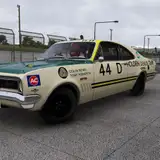
Ford Galaxie 500 Appendix J 1964 (2- Door Version
1964 Sandown Lex Davison #1
1964 Warwick Farm Sir Gawaine Baillie #2
Big Thank you to Velo and Tim for their original model
This Modified Model Version by Bruce Smart who has done an Amazing job in Making the Version that came to Australian.
This is the Appendix J 1964 Model with the Improved production 1965 Model Coming Soon. Also, a Road Version Coming.
This car is available for 30 Days to our Wonderful Supporting Members and with then become Public.
The ‘Australian’ Ford Galaxies…
From : https://primotipo.com/tag/sir-gawaine-baillie/
The Four-Door Sedan – 1962 Model
In 1963 Lex Davison was offered a drive in Len Lukey’s brand new R-Code Holman-Moody built Ford Galaxie four-door sedan. It was LHD 6.7-litre V8 engined Ford Galaxie in full racing trim.
The 405bhp Galaxie was the most powerful racing car in Australia of any sort upon its debut in November 1962.
Into 1963 Lex missed the opening Calder meeting with a dodgy-back, so Norm Beechey took the Galaxie’s wheel .
At Longford Lex was timed on The Flying Mile at 223kmh.
In 1964 Len threw the keys to Beechey. Note that when Lukey’s car arrived some of its H-M goodies were removed to comply with Australia’s Appendix J touring car regs; some panels, bumpers and brakes were amongst the changes. The R-Code car was fitted with a 427 lo-riser big-block Ford side-oiler V8.
All the same, what was somewhat bizarre, given Lex’s experience with Len Lukey’s Galaxie was that he signed up for an even bigger Galaxie challenge, this time involving his own funds.
The Sandown promoters, the Light Car Club of Australia, planned a Six-Hour race for Group 1 cars in November 1964 and sought interest from teams and manufacturers from around the globe.
By September British Galaxie owner/driver Sir Gawaine Baillie had shown interest. Baillie was paired with Davison to share Baillie’s car, which the aristocrat then hoped to sell in Australia after a summers racing.
The Two-Door Hardtop – the 1963 Model
Holman-Moody were approached to produce some road racing versions of the latest 427cid Ford Galaxie factory lightweights, which had been developed for NHRA Super Stock competition on the quarter mile dragstrips throughout the US.
Except for a few early cars such as Lukey’s, these 1963½ Galaxie lightweights all emerged from the factory as white two-door Sports Hardtops with red interiors.
Some featured a Ford 300 series chassis frame made from lighter gauge steel. All body sound-deadening compounds were deleted and lightweight fiberglass replaced steel in construction of the boot lid, bonnet and front mudguards (some had fiberglass doors and inner front guards as well). They also had aluminium front and rear bumpers mounted on lightweight brackets”. The interiors were basic racer-specials with unpadded rubber floor mats, thin-shell bucket seats with no radio, heater or clock or other road going frills.
The engine was Ford’s 427cid side-oiler V8 from the FE big block family with 425bhp and a choice of high-riser and low-riser cast aluminium manifolds running huge dual four-barrel carbs. The high-risers ran in NHRA’s Super Stock category with the low-risers in the slightly less modified A/Stock class.
The gearbox was a butch Borg Warner T10 four-speed manual with cast-aluminium bell-housing and casing to save weight, with a set of close-ratio gears. Ford’s ultra strong, ubiquitous nine-inch rear axle was used with short 4.11:1 final drive and heavy duty leaf springs, shocks and four wheel drum brakes inside 15-inch steel wheels.
A standard 427 Galaxie Sports Hardtop tipped the scales at circa 1900kg, whereas the lightweights were a massive 290 kg less – those fitted with fibreglass doors and front inner guards dropped another 40 kg.
These Ford factory lightweights laid the foundation for the handful of cars produced by Holman-Moody for road racing overseas, one of which was the Sir Gawaine Baillie car. At around 1600kg, they were now competitive with the Jags in weight but with around 500bhp they had a bit (!) more power! The circuit racers, like the drag cars were equipped with lightweight fibreglass front guards, bonnets and boot-lids, aluminium bumpers and stripped interiors.
H-M also developed a front disc brake kit to replace the standard 11-inch drums based on Jaguar 12-inch diameter solid rotors clamped by Girling two-spot calipers mounted on heavy-duty spindles.
“Other H-M tweaks included steel wheels with immensely strong double-thickness centres developed for Grand National (NASCAR) stock car racing. The booming exhaust system was also NASCAR inspired, featuring huge three-inch diameter open pipes neatly routed through the chassis rails that exited in front of the rear wheels. Shock absorber mounting positions were altered with most equipped with two shocks per wheel. Some of the export cars, including Baillie’s, were equipped with an additional shock absorber on the rear axle which through suspension movement pumped diff oil through a remote oil cooler to control rear axle temperatures during races held in warmer climates.”
“The Holman-Moody Galaxie lightweights (with either low-riser or medium-riser 427 engines) were very successful. John Willment’s car soon shook Jaguar out of its complacency in the BTCC, proving dominant in 1960s UK tin-top racing where it was prepared by John Wyer (of Gulf GT40 fame) and driven by Jack Sears and Graham Hill. Another 427 Galaxie campaigned by Alan Brown Racing in the UK also proved highly competitive, driven by such luminaries as Jim Clark, Dan Gurney and Sir Jack Brabham. Baillie had his share of success in the UK…”
Bouyed with the success of the cars in the UK, and convinced the latest lightweight would be a better car than Lukey’s machine, Lex threw himself into the task of dealing with the arrangements to bring the car to Australia, together with a long list of spare parts including a new engine direct from H-M. A separate shipment from the UK comprised extra wheels and racing tyres.
The car was already on the boat when Sandown race organiser Max Newbold realised that the car was modified to Group 2 specs. Borrowing parts from the then dormant Lukey Galaxie would still not have brought the Baillie car within Group 1 so Newbold simply altered the race regulations to include a Group 2 class.
Lex got down to 1:24, Beechey’s lap record in Lukey’s Galaxie was 1:23.5.
Davo reported seeing 5500 rpm in top gear, 217kmh and reported signs of brake fade after 10 laps circulating in the 1:26 mark; it was a portent of things to come.
Baillie left Australia but the Galaxie remained, contesting the one-race 1965 Australian Touring Car Championship in the hands of John Raeburn at Sandown in April 1965. Run to Group C Improved Touring Car regulations.
There was little interest in the car in Australia so it was loaded up and returned to the UK.
While the Galaxie touring car phase of racing in Australia was short it was certainly sweet, if a 1600kg, 500bhp, big, lumbering beastie could ever be described thus!
https://mega.nz/file/YuRFUIwL#dBCZJXz3B2eHI_TpVu8HIMEUmYw3utJIsHzyHqofCtc