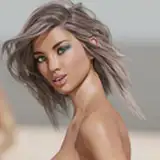
Another one! Every time I work on a figure painting I learn something new about anatomy, color, and light. How muscles change shape depending on the angle of underlying bones and how that affects the shadow shapes created on the surface of the skin. How skin reacts and changes color and temperature at different angles to the light. And so on...
Recently, I've been more cognisant that the darkest parts of the shadow are often the surfaces that are pointing up because they tend to receive less bounce light from the ground. This figure is lit in a studio environment, so there is no skylight to lift the upward-facing areas of the shadow. You can see how dark the shadows get at the top of her hip (just under the lower back) and at the top of her right shoulder because no light (direct or bounce) actually reaches those points.
In other words, you could say these areas are the most occluded from ambient light. Which is where the term Ambient Occlusion (AO) comes from.
Erick Tavares
2023-07-29 13:01:32 +0000 UTC