NokiMo
Primitive Technology

patreon


Down draft kiln

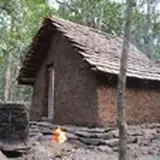
I made a downdraft kiln to test out how it works. A down draft kiln is one where the fire goes up from the firebox into the ware chamber and then is pulled down to an exit flue near the height where it entered, before being drawn up a chimney. Because heat rises, the hottest air stays in the kiln allowing it to reach higher temperatures in theory. This kiln was based off the phoenix down draft invented by George Wright in America in the 1970's. The kiln worked well but the clay for the pots was a bit substandard as I was trying a new source. In future, I'll go back to the normal clay for pottery. Much appreciated.

Down draft kiln

Comments

Yes, I'll test a small one first. I made one 50 cm in diameter and 50 cm tall at home which was a bit big and unwieldy and had to be lifted and dropped rather than used horizontally. Because of this, I considered rocker beam as you described. I used a cloth gasket and the clay piston broke as it slid down the cylinder. It pushed air ok and it's volume would have in theory allowed enough airflow for 3 strokes a minute but I never got to test it on a fire.

Primitive Technology

Yep I've heard of it, will keep it in mind.

Primitive Technology

With your piston type blowers I would not directly operate the piston. I would use a balanced beam the move it, better leverage. This was an often used system in stationary steam engines.

Kenneth Crips

Look up "Tapa Cloth" it is a cloth made from the inner bark of trees. provided you have trees that can be used all you need is water and a wooden beater to soften it. There are numerous tutorials on Youtube on how it is made. Tapa Cloth might give you what you need to make bellows with.

Kenneth Crips

I'll try a piston type bellows as it seems the easiest positive displacement device to make without leather.

Primitive Technology

Thanks Kenneth.

Primitive Technology

Been looking are iron smelting on Youtube and people are getting successful bloomery from their Roman/Middle age smelters. These smelters are no different than what you are building, and they use the same fuel. I you must watch the same YouTubes. What strikes me is the difference is in the bellows. What you are presently using is not moving enough air.

Kenneth Crips

I reckon it's from Indonesia or the Philippines rather than Africa, they had that type of bellows. There would be a plunger sealed with feathers similar to a piston bellows. The difference being that there are no valves. As the stick is lifted, the feathers contract and air passes into the cylinder. When the stick is pushed down, the feathers splay out and push the air into the furnace.

Primitive Technology

https://www.alamy.com/stock-photo-iron-smelting-africa-56726110.html?imageid=AD589FBC-19DF-48A9-8EFF-F6C573F3E164&p=181734&pn=1&searchId=45c90a7eff69643c6f26b937fce2d1d1&searchtype=0

Kenneth Crips

check out the bellows on this African iron smelter.

Kenneth Crips

I'll keep at it. Once I have the iron, I'm able to melt it ok with the current blower. There was one video where I melted the cast iron prills into a lump of malleable iron that I was able to forge flat. I'll keep experimenting. Thanks.

Primitive Technology

Was looking at the downdraft kiln design and much larger versions were used for pottery kilns in the UK in the early 19th century. The TV show Time Team has excavated a number of them. I seems to me you are getting a handle on your furnaces it is the forced air feed that is holding you up on getting a good Iron ore melt. With in the context of your show there is no way to obtain hides for tanning to make bellows with. You actually have most of what you would need to do it. The bark of the Black wattle, and the Eucalyptus contain high amounts of tannin.

Kenneth Crips

Probably well, it would be heated first to temperature and then the thermal mass would cook the pizza. Thanks.

Primitive Technology

It gets out the big pieces of stone which is time consuming to pick out by hand. Then the stuff you add back is of a known size which is crushed before hand. Thanks.

Primitive Technology

It would be best to cover such a kiln, but I'll likely demolish it and make a different one from bricks. It won't last long with heavy rain. Thanks.

Primitive Technology

How well would this kiln serve as a pizza oven?

Amy Tobol

I know nothing about clay, but it's bothering me that you remove the grit and impurities, and then add even worse grit and impurities right back in. Maybe coarser, less refined clay would crack less?

Amy Tobol

How does this style kiln handle being out in the open? Will you build a structure to cover it?

Bryan

Definitely more efficient than the updraft kiln as the fire is more enclosed and the hotter flames stay in the kiln with the cooler ones leaving first. The opposite is true for an updraft kiln as the hotter flames leave first as hot air rises. Very fast too. Thanks.

Primitive Technology

Does this design use similar amount of fuel as other more open designs or is it a bit more efficient from that point of view?

Giovanni Barbera

It may be best to learn iron because it's more common than copper.

Primitive Technology

Clay would work I reckon.

Primitive Technology

The best copper ore in Australia comes from the New South Wales, CSA mine. Which is a bit far to go for copper to smelt.

Kenneth Crips

The Japanese swordsmiths blower is entirely made out of wood. The problem I see for you to build one is to somehow fashioning the boards to make it with. I did see one made elsewhere out of a hollowed out log.

Kenneth Crips

Canvas was also used in place of leather for bellows. It might be possible to weave some bark fiber into cloth for this use. I don't think it has to be completely air tight to work.

Primitive Technology

Yes, I just have difficulty obtaining such materials. May be it might be possible to make one from woven fiber that was sealed with oil or resin. I'll look into it.

Primitive Technology

I have actually smelted copper at home, using my hand powered blower design (as seen in my iron smelting videos). I used Malachite that I got off the internet from a site that sells it for lapidary work. It was a high quality ore mined in an African country. I smelted it in a pit about 25 cm wide and 12.5 cm deep with charcoal and the blower. It made about half it's weight from ore in copper in a large chunk and smaller prills, far better than the yield I get for iron ore. I was then able to melt it into a crude axe head for a promo for some TV executives. I can't find any good ore hear though of copper. I went to Chillagoe and found some ore that fell off the trains but it was far worse quality and only made a few tiny prills.

Primitive Technology

Have you considered ever doing a smelting furnace powered by a bag instead of the fan blower method you use?

BrokenPancreas

It heats more carefully with less temperature variation and possibly reaches a higher temperature. The pots did crack but this was due to poor clay, as I was testing a new source of white clay from a flood plain (will go back to clay from creek banks now). But I think if using normal clay it would be less likely to crack. It should reach a higher temperature as we saw in the video with the pots glowing yellow hot after a short time. Because the flames go up and are then pulled down in the ware chamber, only the coolest flame can leave the chamber through the chimney. This means the hotter flame stays in the chamber leading to a higher temperature in theory. More experiments are necessary. Thanks.

Primitive Technology

Have you looked into the copper smelting technology developed in Jordan about 2000 BCE? They had natural draft furnaces that were processing large amounts of copper ore. This area supplied a large portion of the copper used in rhe Eastern Mediterranean Bronze manufacturing.

Kenneth Crips

Looks very interesting. How does it compare with your other designs?

Ken Clark


Related Creators