Character bio #10: Aten-Ko the Equitaur
Added 2021-01-03 11:45:53 +0000 UTCBio
There are many species in the world, of every shape and sort imaginable, and after millennia of sometimes awkward, sometimes violent coexistence, they have spread across the full face of the globe. In the modern enlightened age, most would agree that all people are equal, no matter how they look or sound, and should be limited only by their circumstances and drive. So today, a horse is no longer considered only capable of physical labour, and otters can be found doing jobs that have no relation whatsoever to bodies of water. The convention of civility grants all a level footing.
But that variety remains something of a mystery to those who would study these things. How did so many disparate species arise more or less concurrently? What gave most of them such similar forms? Natural philosophers are fascinated by these questions, and delve ever deeper into the mysteries to find the truths at their heart. But even they must profess ignorance—or, at most, such a proliferation of theories as to render any consensus impossible to discern—on the topic of one peculiar category of people: the hybrids.
The ability for most species to interbreed with impunity—another mystery to taunt the philosophers in their sleep—always results in progeny that reflect the species of only one parent, with perhaps some traits of the other parent showing in minor ways. Never does the spawn reflect both species. This makes the undeniable existence of hybrids a paradox that has flummoxed people for centuries. People who take the form of two—or more!— species, clearly and unambiguously delineated, yet themselves not part of either. How did such creatures come into existence? Did the natural mechanisms now seen amongst all kinds not always apply?
Wherefore, in short, hybrids?
For most people, questions of such an existential nature are already answered. There are many lands, and many myths about the creation of the world and those who now live within it. They are ancient, one and all—some more ancient than others. More than a handful of them are concerned with the origin of hybrids, such as this tale from Paardenrust Valley itself, which has been told amongst the people that have lived there for over six hundred years (although the myth is almost certainly of much older provenance than that; certainly several millennia):
In the early times, all people were alike unto their forms. Proud Lion striding tall with his mane of gold, or steadfast Zebra with his bright stripes, or wily Leopard, watching from the shadows - each was distinct. Even though Lion might come to Leopard in the night, to mount her with growls and barbed thrusts, his kittens would not have proud manes and patterned stripes, but be only lions, or leopards.
But Watching Bird saw this all from his high tree, and he grew curious, for he desired to know if the peoples could change. And so he flew to the magic mountain, and hit his beak upon the cliff until it cracked and released the shining waters within. And Watching Bird took the water in his beak, and flew back to the peoples, and dropped it into their evening beer, and the peoples drank deeply of it, unknowingly.
And the people found that they were filled with lust for one another, and their loins burned with desperate need. And all the peoples did mate with one another, and many children were conceived. And then Watching Bird caused the peoples to fall asleep, and brought their children forth, and when the people woke, they had children of many forms. But the people did not accept their new children, for they did not look like them, and the children grew fraught, and they rebelled against their parents and were cast out into the world.
This myth—and others, including several that describe hybrids as having been created by various deific forces to be stronger and fiercer (and, by implication, more bestial and less controlled) than other species—betrays a common belief about hybrids: that their nature is somehow broken. That their multipartite aspects are a reflection of a singular, innate flaw which stems from birth and cannot be overcome.
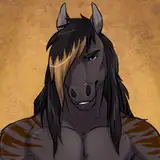
This, then, is the world in which Aten-Ko the equitaur— as well as satyrs, minotaurs and other species who display split physical attributes—find themselves. The convention of civility that grants other species a nominally level footing is strained to breaking point in the presence of hybrids. They are seen warily by many, considered to have to exert constant effort to remain in control, and to be possessed of an intrinsically violent nature which—it is held—can appear at any moment.
Aten-Ko was not born in Paardenrust; not even in the same country. He was brought here as a child by his parents, and grew up in a variety of cities until finally settling, as an adult, in Paardenrust. He has found work as a gardener at the manor house, and finds satisfaction in that. Plants, after all, do not pass judgement. He has chosen not to stay at the manor house, choosing instead to live in the forest commune with the community of malefics: a group with their own experience of prejudgement, and a greater willingness to embrace people of any origin.
In amidst all of the emotion and the superstition, however, there is one fact about hybrids that has gone unnoticed by the inhabitants of this world. It’s understandable, given how difficult it would be to determine, how many people would have to be interviewed and trusted to be telling the truth, but nonetheless interesting.
No hybrid has ever been malefic.
Character
Life—or, more precisely, the people in it and how they perceive him—has led Aten-Ko to develop an inhibited personality, preferring to keep to himself when possible. When he does have to interact with others, he takes care to be understanding and helpful, seeking to give others no grounds to consider him anything less than a model citizen. It helps. It’s not always enough, given the superstitions, but it helps.
He has a love of learning from years spent alone with books as a child, and has a good relationship with the manor’s librarian, Ta’kom Ironhoof. Most nights will find the equitaur in his home, under a single flickering lamp, poring over some new tome borrowed from the manor’s voluminous collection.
His restrained personality is sometimes only skin-deep; get him drunk, and you will find an entirely new person: boisterous, friendly, and casually sexual. You might struggle to keep your eyes from the display he puts on…and he might not want you to.
Kinks & Sexual Ethology
Aten-Ko‘s physiology has been both a boon and a curse to him. Finding other quadrupeds to mate with in the default manner of his kind is difficult, but finding other people eager to experience and pleasure his large body—and larger penis—has not been a challenge.
And that’s good because, despite the care Aten-Ko takes to project a calm, measured personality, he has powerful lusts. There is inside him an insatiable desire to mate, to breed: to mount others, to fuck them fast and fiercely, to ensure they carry his seed. All males are suitable to him, but he finds other equines especially desirable.
If he cannot schedule a tryst with one of the many males in the town who near-worship him, he will simply take care of things himself, and more than one neighbour has woken to the rhythmic slapping of horsecock against belly, and found themselves uncontrollably turned on.
Design Goals
I enjoy hybrid characters a lot, so I knew I wanted one in. Given how physically distinct he is, I also saw an opportunity for some interesting worldbuilding around hybrids, and I definitely fell deep down that hole.
Plus: giant swinging horsecocks under huge horse bodies.
Comments
Loving the lore behind your hybrids and the world, particularly the myths <3 Enough information to be able to understand what's what, but just as many questions that can't be answered to keep you wanting to learn more!
Arktisk
2021-01-03 11:53:09 +0000 UTC